
Panoramic X-ray (orthopantomogram)
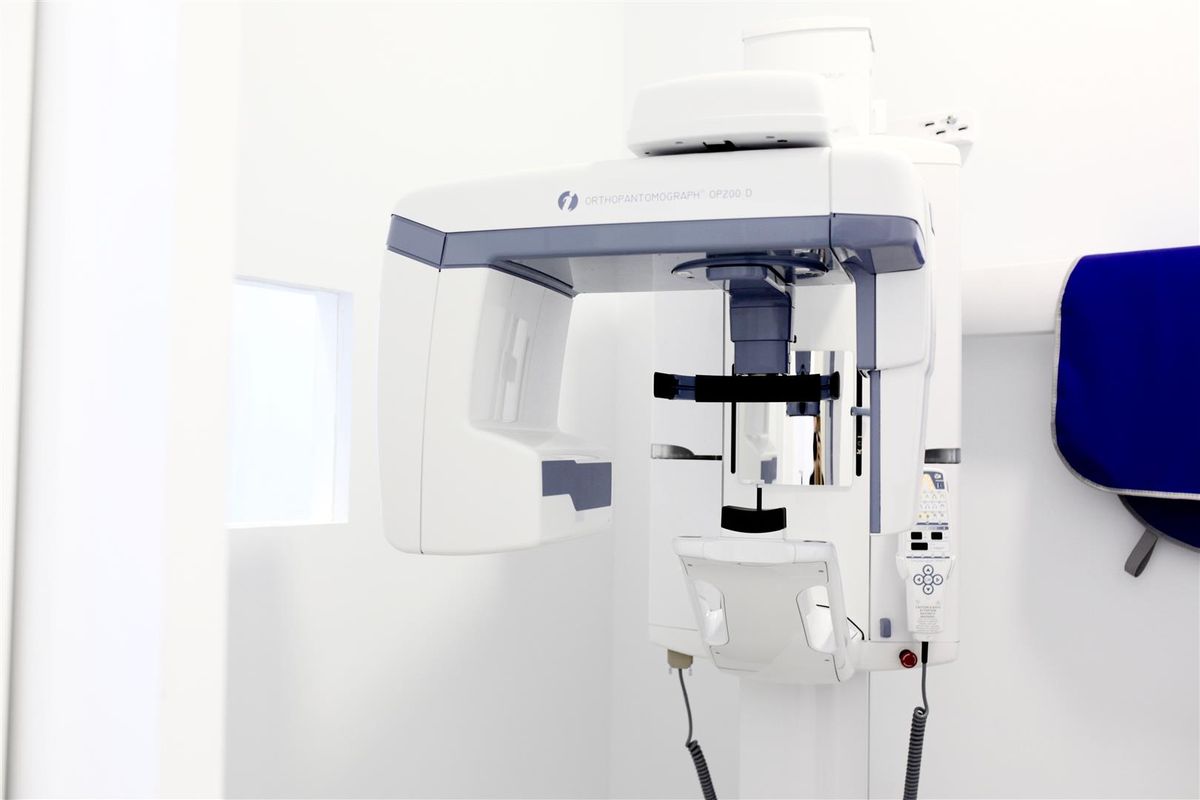
The panoramic X-ray shows the teeth, upper jaw and mandible in a single image and at a minimal dose. What it shows, when it is requested and how it is done.
What a panoramic X-ray is
The orthopantomogram —the panoramic X-ray everyone knows— captures the whole mouth in a single image: the upper and lower teeth, their roots, the maxilla, the mandible, the maxillary sinuses and both joints. The machine turns around your head while you bite on a plastic piece, and the exposure takes less than a minute.
It is the overall view with which almost any dental study begins. It does not replace your dentist's examination: it completes it, and it is requested when that examination shows it is needed.
Why it is requested
- Study prior to implants, prostheses or full mouth rehabilitation.
- Position of the wisdom teeth and of teeth that have not come through.
- Initial orthodonticstudy: which teeth are present, where they are and how the change of teeth is progressing in children and adolescents.
- Suspected cysts, granulomas or other lesions of the jaws.
- Generalised bone loss in gum disease.
- Trauma and follow-up of treatments already carried out.
When it is not needed
A panoramic X-ray is not a screening test. The reference guidelines are clear on two points: the X-ray is decided on after examining the mouth, never before and never «as a matter of course» by protocol, and it is not repeated on a set schedule, but when something has changed.
Nor is it the best test for everything. For decay hidden between two teeth, an intraoral X-rayshows far more; and for measuring bone before surgery it falls short, because it flattens into one plane something that has volume.
What the test is like
Standing or sitting, with your chin resting on a support and biting on a small plastic piece. You have to remove all metal from your head and neck —earrings, glasses, piercings, hairpins, necklaces and removable dentures— and stay completely still while the arm goes around: movement blurs the image and means it has to be repeated.
The three questions we are asked most: it does not hurt —nothing goes into the mouth apart from the bite piece—, it takes less than a minute and there is no need to fast or prepare anything.
How much radiation it involves
Dental X-rays are among the lowest-dose tests in the whole of medical radiology, and with digital equipment the exposure is lower still than with film. A panoramic X-ray amounts to roughly the natural background radiation anyone receives in one or two days of ordinary life.
A low dose does not make it harmless, which is why each test is requested because it is going to change a clinical decision, not out of routine.
Pregnancy, breastfeeding and children
If you are pregnant or think you may be, tell us before the test, without waiting to be asked. Dental X-rays use very low doses and the beam stays well away from the abdomen, so they are not contraindicated when they are necessary —an undiagnosed dental infection usually poses more risk than the X-ray—, but your dentist will consider with you whether it is better to wait. While breastfeeding there is no special precaution at all: it does not affect the milk.
In children and adolescents the same criterion applies, all the more so: the test that is needed, when it is needed, and with the equipment adjusted to their size.
After the test
The image appears on the screen straight away and your dentist explains it to you during the same visit, pointing out on it what has been found. We give it to you in digital format if you need it for another professional.
If the panoramic X-ray leaves questions unanswered —above all when bone has to be measured before surgery— the next step is the 3D dental scan. In orthodontic studies it is usually accompanied by the lateral cephalometric X-ray.
How to request it
Normally your dentist will recommend it during the appointment and it is done there and then, in the clinic itself. The cost depends on whether the test is done on its own or forms part of a wider study: we confirm it when you book, before it is carried out.
If you have been referred by another professional with the panoramic X-ray already requested, we can also do it for you: book an appointment and tell us what you have been asked for.
Frequently asked questions
What is a panoramic X-ray and why is it requested at the dentist?
It is the X-ray that captures all the teeth, the jaws and the jaw joint in a single image. It is the starting test for the first check-up, for assessing the wisdom teeth and for planning orthodontics, prostheses or implants.
Do I have to remove anything beforehand?
Yes: earrings, glasses, piercings, necklaces, hairpins and removable dentures. Any metal shows up on the image and can hide what needs to be seen. You also have to stay completely still while the arm rotates, because movement blurs the image.
Is it useful for seeing caries?
It is useful for getting the overall picture and detecting large caries, cysts or bone loss, but small caries between teeth are seen much better on an intraoral bitewing radiograph. That is why both are often requested.
What can an orthopantomogram detect?
Large cavities and lesions between teeth, bone level, cysts and lesions of the jaws, impacted teeth and wisdom teeth, retained roots, the condition of previous implants and root canals, and the jaw joint. It is the overall picture: for fine detail of a single tooth an intraoral X-ray is used.
What is the difference between a panoramic X-ray and a CT scan?
The panoramic X-ray is a flat, two-dimensional image: it gives the overall view. The CT scan —or the cone beam dental scanner— reconstructs the area in three dimensions and makes it possible to measure bone and see the exact position of nerves and roots, with a higher radiation dose. It is requested when surgery or implants have to be planned.
How long does an orthopantomogram take?
The scan itself takes less than a minute; between getting into position and removing metal objects, the whole visit is just a few minutes. The image is obtained instantly with digital equipment and can be viewed during the same appointment.