
Intraoral X-ray
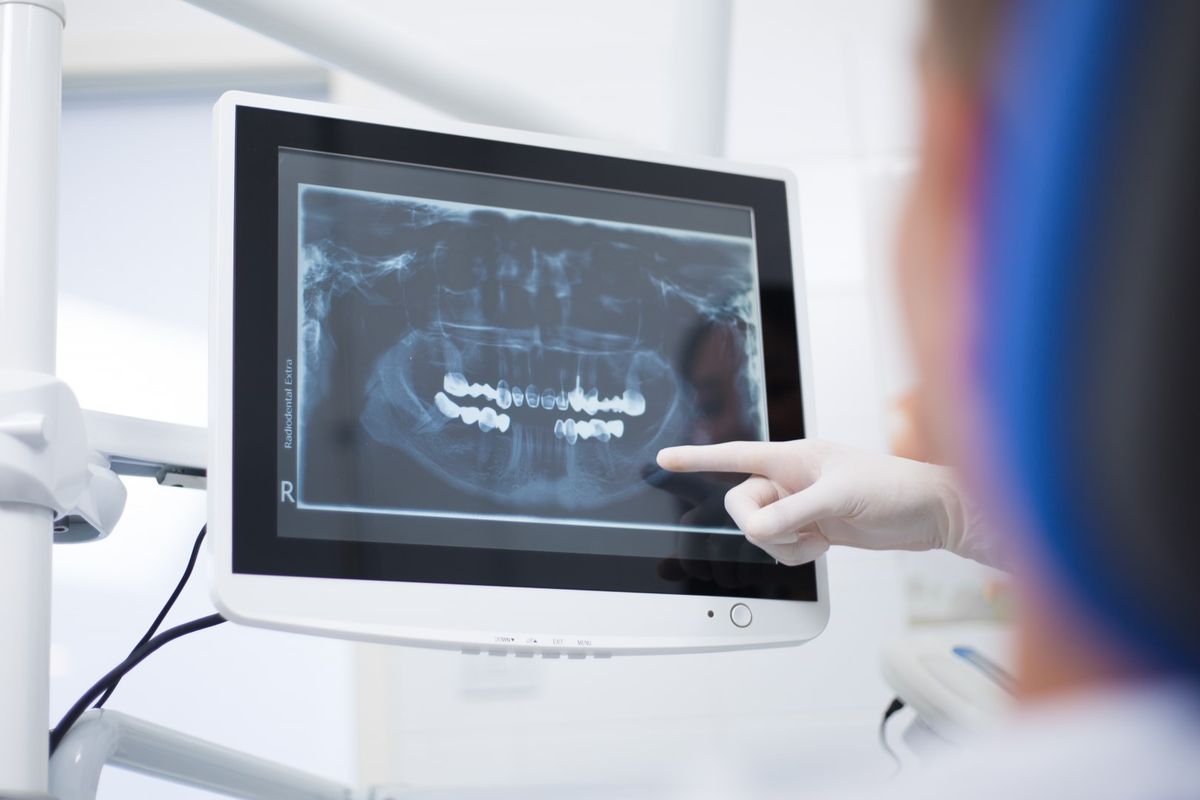
The X-ray taken with the sensor inside the mouth: it is used to see decay between teeth and the condition of the roots. Types and how it is carried out.
What it is
The intraoral X-ray is taken with a sensor placed inside the mouth, right against the tooth being studied. It covers a small area, but with a level of detail no other dental test can match. There are two types in daily use:
- Periapical: the whole tooth, including the tip of the root and the bone around it. This is the one for when something hurts and we need to see why.
- Bitewing: the crowns of the upper and lower teeth in the same image. It is by far the best for finding decay hidden between two teeth, where neither the mirror nor the panoramic X-ray can reach.
When it is done
- Diagnosis of decay, especially the kind that sits between teeth and cannot be seen with the naked eye.
- Before, during and after root canal treatment: to measure the canal, check the work and confirm the seal.
- Assessment of an abscess, a granuloma or a cyst at the tip of the root.
- Assessment of the bone in gum disease.
- Long-term monitoring of fillings, crowns and implants.
How often it is repeated
There is no fixed number that works for everyone. The interval between follow-up X-rays is set by your risk of decay —whether you have had recent decay, the state of your gums, what you eat, how you brush— not by the calendar. Someone with a stable mouth has them spaced well apart; someone going through an active phase has them more often. And in any case the test is decided on after looking at the mouth, never before.
What it is like
The sensor is placed, you are asked to bite gently and stay still for a second. And that is it: it does not hurt, there is no preparation beforehand and no need to fast.
The only thing that can be uncomfortable is the sensor resting against the palate or the floor of the mouth if you have a gag reflex. Say so before we start rather than afterwards: the position can be changed, a different holder used or another view taken. It is a well-known problem and it has a solution.
How much radiation it involves
It is the lowest-dose test in the dental surgery. With a digital sensor, an intraoral X-ray amounts to less than the natural background radiation you receive in a single day. Even so it is requested with good reason, not one after another.
If you are pregnant or think you may be, please let us know. Dental X-rays are not contraindicated in pregnancy when they are necessary —leaving an infection undiagnosed usually poses more risk— but it is best that we know so we can consider it with you. While breastfeeding there is no special precaution at all.
What it is combined with
Each test answers a different question. The intraoral X-ray tells us what is wrong with this tooth; the panoramic X-ray gives the overall view of the whole mouth; and the 3D dental scan supplies the volume when surgery has to be planned or a root is proving stubborn.
The image appears on the screen within seconds, so your dentist shows it to you and explains it during the same visit. If you have discomfort in a particular tooth, book an appointment and we will take a look.
Frequently asked questions
Why is the sensor placed inside my mouth?
Because placing it next to the tooth gives far more detail than any image taken from outside: the whole root can be seen, along with the bone around it and the decay that hides between teeth. All you have to do is bite gently and stay still for a second.
What is a bitewing X-ray?
It is the one that shows the upper and lower crowns on one side at the same time. It is the best for detecting interproximal cavities, those that sit between one tooth and the next and cannot be seen with the naked eye, and for monitoring bone levels at check-ups.
Is it repeated at every check-up?
Not automatically. The frequency depends on your caries risk and on what is being monitored: in healthy mouths they are spaced well apart, and in patients with frequent caries or gum disease they are repeated more often, always with justification.