
Clinical biomechanics: biomechanical testing and functional assessment of injuries
Instrumented tests measuring mobility, strength, fatigue, gait and balance to put numbers on an injury. The result is a medical report that serves whoever needs to make a decision: mutual insurers, insurance companies, lawyers, referring physicians or patients themselves.
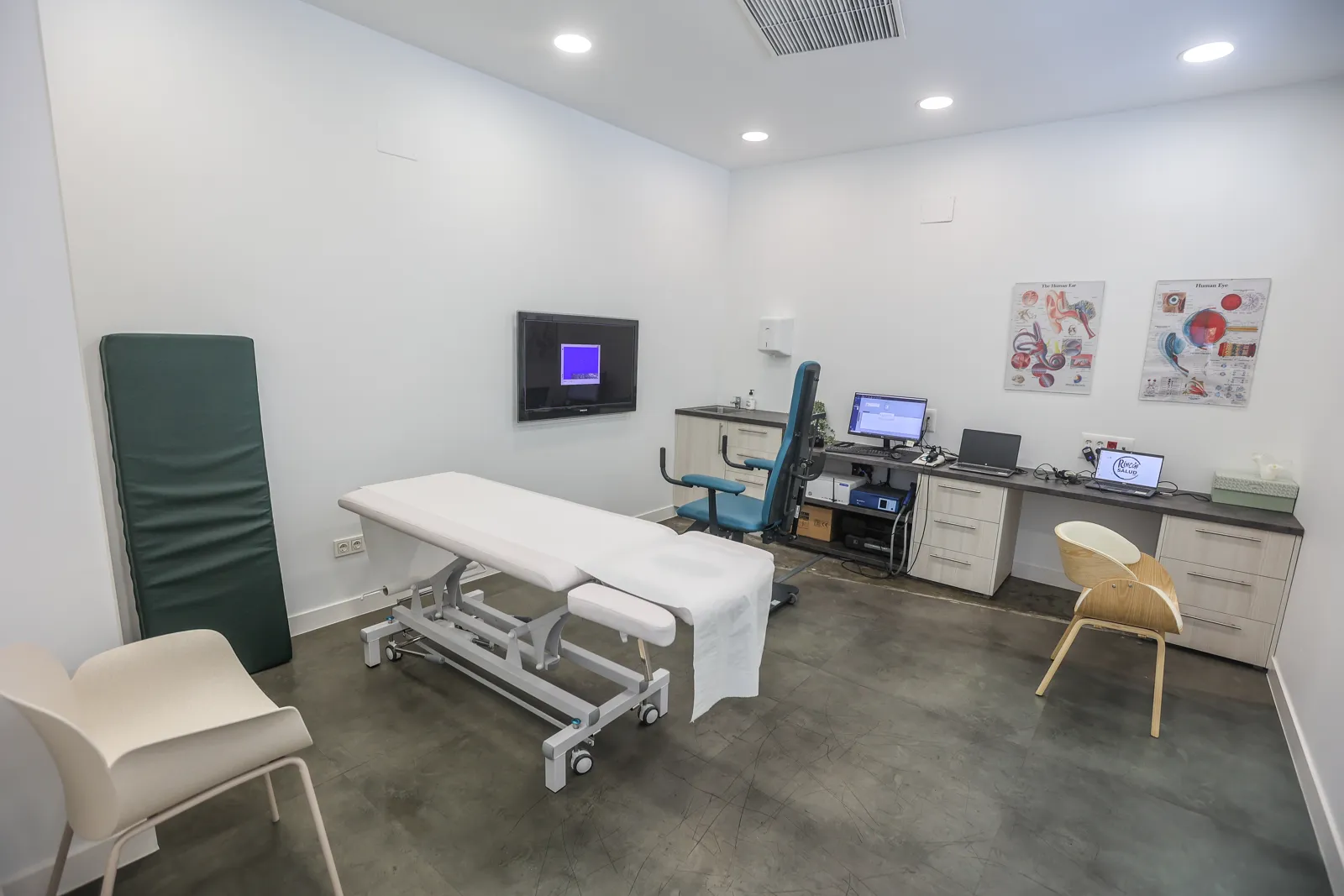
The clinical examination of an injury relies on two things that cannot be measured by hand: what the patient reports and what the examiner observes. Clinical biomechanics adds what is missing: instruments that record how much a joint moves, how much force a muscle group generates, how long it takes to fatigue, how load is distributed when walking or how balance is maintained. With these measurements, it is possible to determine, using data, whether a region of the body functions normally, how far it deviates from expected values, and how it evolves throughout treatment.
The clinical biomechanics unit at Rincón Salud is located at the medical centre in Málaga (La Rosaleda), in the same centre as the Vestibular Unit. It is a diagnostic service: here, measurements are taken and reported; treatment is managed by the referring physician.
What a biomechanical test is for
There are four situations in which an objective measurement helps in decision-making:
- After a road traffic accident. Track the recovery of whiplash or low back pain with data, confirm that the region has normalised prior to discharge, and document sequelae when recovery is incomplete.
- Occupational health and disability. Determine whether a worker can safely return to work, whether a limitation justifies a job role modification, or whether there are grounds for disability evaluation.
- Support for the treating physician. General practitioners, orthopaedic surgeons and rehabilitation specialists often lack functional tests: chronic neck pain, tendinitis that fails to improve, or a knee that does not fully respond are better monitored using measurements rather than clinical impressions.
- Sports. Provide data to decide when to return to training following an injury and establish your baseline before the season starts.
What is measured and in which anatomical regions
Each region has its own protocol. Tests are selected based on the reason for evaluation: not all tests are performed on everyone.
Region |
What is measured |
|---|---|
| Cervical spine | Range of motion, three-dimensional movement velocity, muscle tone, cervical strength and balance. |
| Thoracolumbar spine | Range and velocity of movement, muscle tone, lumbar strength, leg muscle balance and gait analysis. |
| Shoulder, elbow and wrist | Active and passive three-dimensional mobility, hand grip strength and joint-specific strength. |
| Hand | Mobility, power grip strength, pinch grip strength and grip fatigue. |
| Hip, knee and ankle | Three-dimensional mobility, joint-specific muscle strength and gait analysis with plantar pressure recording. |
| Balance | Posturography (how standing balance is maintained, with and without visual cues) and gait analysis. Used following head trauma or in Ménière's disease. |
| Global assessment | Cervical and lumbar mobility, back muscle tone and fatigue, hand grip strength and gait. Used in fibromyalgia and chronic fatigue. |
What is not performed here is gait analysis for orthotics or running: that is the Podiatry biomechanical gait analysis, which is a separate consultation.
What the test involves
Before. A medical referral indicating what needs to be evaluated is required: from a mutual insurer or insurance doctor, a sports physician, your treating doctor, or a request from your lawyer or medical expert. Based on this referral, the regions and tests are selected. Please also bring any available medical reports and imaging studies (X-rays, MRI), the accident report if applicable, and comfortable clothing.
During. Tests are performed following the protocol for each region: motion sensors, dynamometers for strength, pressure plates for gait and balance, and surface electromyography for muscle activity. These are non-invasive tests: the patient is asked to move, exert force or walk, within the limits of their injury. Assessment of a single region takes around one hour.
After. The unit's physician analyses the measurements, compares them with reference values, and drafts the report. The final report is delivered within a maximum of 72 hours from the test, and an urgent channel is available to deliver it in under 48 hours when required by legal or administrative proceedings.
What the report contains
A signed medical report describing the tests performed, the measurements obtained, their comparison with expected values for the patient's age and sex, and a conclusion on the functional status of the evaluated region. When a previous assessment exists, it includes the patient's progress. Protocols incorporate consistency checks to verify whether results are coherent across repetitions. These aid in test interpretation, but alone they do not prove whether someone is exaggerating, as pain or fear of re-injury can also influence results. The report is a clinical document; its use as evidence in proceedings is decided by the party handling the case.
Who performs it
The unit is directed by Dr. Yasmina Domínguez Ponce, a specialist in physical medicine and rehabilitation, who supervises every case and signs the reports. When required, we collaborate with the group's own orthopaedic surgery and physiotherapy departments.
For mutual insurers, insurance companies, law firms and doctors
If you regularly refer patients, the unit works with occupational accident mutual insurers, motor insurance companies, civil liability law firms, medical experts and occupational health services. To refer a patient, simply state the reason for evaluation and the regions to be examined; you will receive the report within the agreed timeframe and, if required, a follow-up assessment at the end of treatment. Corporate terms are provided upon request.
- Telephone: 900 52 52 84
- Email: info@salud101.es
- Location: Málaga medical centre (La Rosaleda), Cam. la Palmilla, 6, Palma-Palmilla, 29011 Málaga
Book an appointment
Assessments are carried out by referral: usually from a mutual insurer's doctor, a sports physician, or a lawyer. If you are a patient and require one for a legal or administrative procedure, ask the person handling your case to specify what needs to be evaluated, and book an appointment at the La Rosaleda centre with that referral and your medical reports.
Frequently asked questions
What is a biomechanical test?
An instrumental measurement of how a region of the body functions: how much it moves, how much force it exerts, how it fatigues, how it walks, or how it maintains balance. It is carried out using sensors, dynamometers, and platforms, and the result is compared with reference values to determine if there is a limitation and to what extent.
What happens during a biomechanical assessment? Does it hurt or cause side effects?
You will be asked to move the area being examined, exert force and, depending on the case, walk or stand on a platform, while sensors, a dynamometer and, in some protocols, surface adhesive electrodes record what occurs. Each exercise is repeated several times and performed gradually, always within the limits of what the injury permits. There are no needles, radiation or contrast agents; the most common outcome afterwards is mild fatigue or muscle soreness in the worked area. If you have heart disease, poorly controlled diabetes or a high-risk pregnancy, please mention this when booking your appointment so the doctor can evaluate it.
How long does it take and what do I need to bring?
Around one hour per region. Bring the prescription indicating what needs to be evaluated, any medical reports and imaging tests you have, the accident or mutual insurance report if applicable, and comfortable clothing.
Can the report be used as evidence in court or before a mutual insurer?
The report is a medical document containing objective measurements and effort consistency tests, and is drafted so that it can be submitted in legal proceedings. Who assesses it and the weight given to it is decided by the expert witness, the organisation or the judge who receives it.
Is it the same as a gait analysis?
No. A gait analysis evaluates foot support to prescribe insoles or correct running technique, and is carried out by Podiatry. Here, the function of any body region is assessed to document an injury. If your query is about gait analysis, it is on this other page.
Is it covered by my mutual society or insurance?
It depends on who requests the assessment. If you are referred by your occupational accident mutual society or your insurance company, they will manage it. If you come on your own, call us on 900 52 52 84 and we will explain how it works.
Are biomechanical tests reliable?
They are reliable when performed using calibrated instruments, standardised protocols, and reference values by age and sex, although reliability varies depending on the method and test, and studies still point out weaknesses. The sensor records the degrees of movement, the dynamometer measures force, and the platform assesses balance, and the result is compared with expected values. They have three limitations worth knowing: they depend in part on your effort, they do not measure pain directly, but rather its effect on function, and they are a complementary test, which is interpreted alongside the clinical examination and imaging tests.
Does the test detect whether someone exaggerates or fails to co-operate?
Protocols include consistency checks: each test is repeated, and it is verified that the results are consistent across repetitions and between different tests measuring the same parameter. If they are not, the report reflects this as insufficient co-operation or non-assessable results; no one is labelled, but that part of the test ceases to serve as usable data. Even so, the fact that the results do not align does not in itself prove that someone is exaggerating: pain, fear of hurting oneself, or the injury itself can also have an influence. The best thing for the patient is to perform each exercise with the maximum effort that pain allows: a real limitation is measured, and a consistent result is what gives value to the report for whoever receives it.
What is the difference between a biomechanical test and a personal injury assessment?
They are two distinct documents that complement each other. The biomechanical test measures how a body region functions at the time of the examination: mobility, strength, fatigue, gait or balance, expressed in figures. A personal injury assessment is the medico-legal report drawn up by a medical expert: it integrates the medical history, imaging tests, clinical progress and, if available, the biomechanical test, and is what applies the assessment scale or rules on fitness for work. We perform the former here; if you need the latter, your lawyer or medical expert will tell you how to incorporate our report.
Why is the uninjured side also measured?
Because the most useful reference point is yourself. Comparing the injured side with the healthy side, taking into account whether you are right- or left-handed, allows us to determine how much you have lost relative to your own baseline, rather than just compared to a population reference table. In regions without a counterpart, such as the spine, the comparison is made solely against reference values by age and sex.
Do I need a referral or a medical report to have the test?
Yes. The assessment is carried out with a referral or request specifying what needs to be evaluated: from your health insurance or mutual doctor, your sports doctor or GP, or a request from your lawyer or expert witness. Please also bring any imaging scans and previous reports. If you do not have one, ask whoever is handling your case or your doctor for it.
Can I request a copy of the report and my test records?
Yes. The report is your clinical documentation, and you have the right to access it and obtain a copy, regardless of who requested the test (Law 41/2002 on Patient Autonomy). The report describes the tests performed, the parameters measured, their comparison with reference values, and, if there was a previous assessment, your progress.
Areas within this specialty
Based on reliable sources
Prepared by our team from the references listed below. This is general information and does not replace a consultation.
Content pending review by one of our doctors.
References (7)
- Instituto de Biomecánica de Valencia. Tecnología para el análisis biomecánico y la valoración funcional (LVF-IBV) Open
- Gouttebarge V, Wind H, Kuijer PP, Frings-Dresen MH. International Archives of Occupational and Environmental Health (2004). Reliability and validity of Functional Capacity Evaluation methods: a systematic review with reference to Blankenship system, Ergos work simulator, Ergo-Kit and Isernhagen work system Open
- De Baets S, Calders P, Schalley N, et al. Journal of Occupational Rehabilitation (2018). Updating the Evidence on Functional Capacity Evaluation Methods: A Systematic Review Open
- Shechtman O, Anton SD, Kanasky WF, Robinson ME. Work (2006). The use of the coefficient of variation in detecting sincerity of effort: a meta-analysis Open
- Meekins GD, So Y, Quan D. Muscle & Nerve (2008). American Association of Neuromuscular & Electrodiagnostic Medicine evidenced-based review: use of surface electromyography in the diagnosis and study of neuromuscular disorders Open
- Row J, Chan L, Damiano D, et al. Journal of Neurotrauma (2019). Balance Assessment in Traumatic Brain Injury: A Comparison of the Sensory Organization and Limits of Stability Tests Open
- Boletín Oficial del Estado. Ley 41/2002, básica reguladora de la autonomía del paciente (artículo 18, acceso a la historia clínica) Open