
24-hour Holter monitor
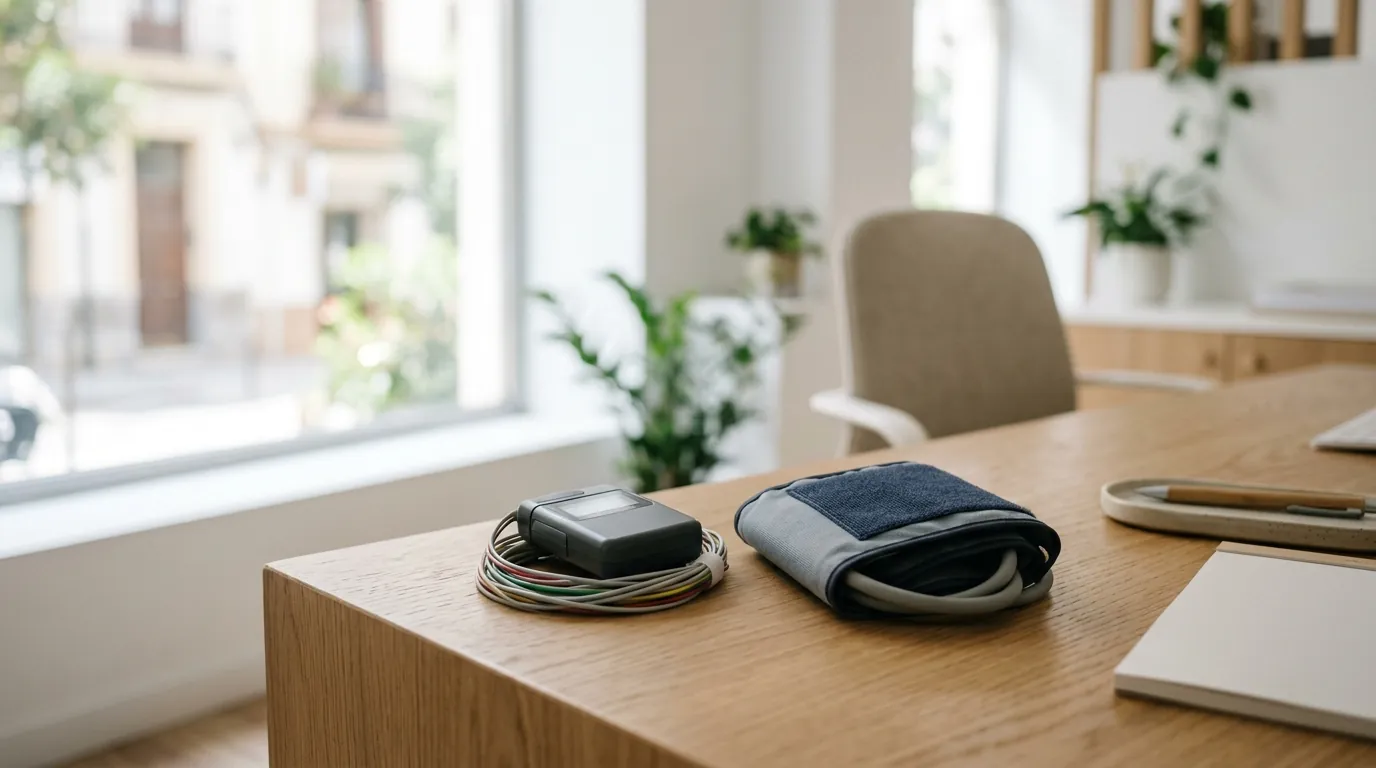
ECG and blood pressure (ABPM) Holter monitoring: a continuous 24-hour recording to catch arrhythmias and measure your blood pressure during normal life.
Two tests with the same name
«Holter» refers to recordings worn for a whole day while you go about normal life. There are two, and they're not the same:
- ECG Holter: a small recorder with electrodes that logs every heartbeat over 24 hours or more. Used to catch arrhythmias that come and go.
- Blood pressure Holter (ABPM): a cuff that inflates at intervals, day and night, mapping your real blood pressure away from the clinic.
Why 24 hours and not a snapshot
A normal electrocardiogram doesn't rule out an intermittent arrhythmia: if your palpitations last two minutes a week, they're unlikely to coincide with the test. Something similar happens with blood pressure: some people only have high readings at the clinic — so-called white coat hypertension — and others are high specifically at night, which is what's more concerning. Continuous monitoring settles both questions.
How to wear it
- Go about your normal life: that's exactly what's being measured.
- Note down on the sheet what happens to you and when — palpitations, dizziness, pain — and also when you go to bed.
- Don't get the device wet: no showers that day.
- With the ABPM, when the cuff inflates, keep your arm still and relaxed.
The report
When you return the device, the recording is downloaded and the cardiologist analyses it alongside your notes: that's where the test earns its value, cross-referencing what you felt with what your heart was doing at that moment.
Frequently asked questions
Can I shower while wearing the Holter monitor?
No. The device must not get wet, so there is no shower or bath during that day. It is the only significant restriction, because in everything else you are asked to do exactly the opposite: carry on as normal, including your work and your usual activity, which is precisely what we want to measure.
What is the symptom diary for?
To match what you felt with what your heart was doing at that moment. Note down the time of any palpitations, dizziness or pain, and also when you go to bed and get up. A recording without notes loses much of its value.
How does an ECG Holter differ from a blood pressure one?
The ECG one records every heartbeat over 24 hours or more and is used to catch arrhythmias that come and go. The blood pressure one, or ABPM, uses a cuff that inflates at intervals during the day and night and maps your real blood pressure outside the clinic, where white-coat effect and night-time pressure show up.
What should you avoid doing while wearing a Holter monitor?
Do not get it wet —no shower or bath that day—, do not peel off the electrodes or unplug the cables, and do not forget to note down your symptoms and the times they occur. What you should do is carry on with your normal life, including work and your usual activity: if you change your routine, the recording loses its value.
Which conditions does the 24-hour Holter monitor detect?
Arrhythmias that come and go —atrial fibrillation, extrasystoles, tachycardias—, pauses and conduction blocks, and the relationship between your symptoms and what the heart is doing at that moment. In its blood pressure version (ABPM), it detects masked, white-coat and nocturnal hypertension.
Questions and comments
Ask the specialist who reviews this page or leave us a comment. Everything is reviewed before it is published.
To write, first confirm your email: we will send you a code.
Content reviewed by Dr David Grande Prada