
Electrocardiogram
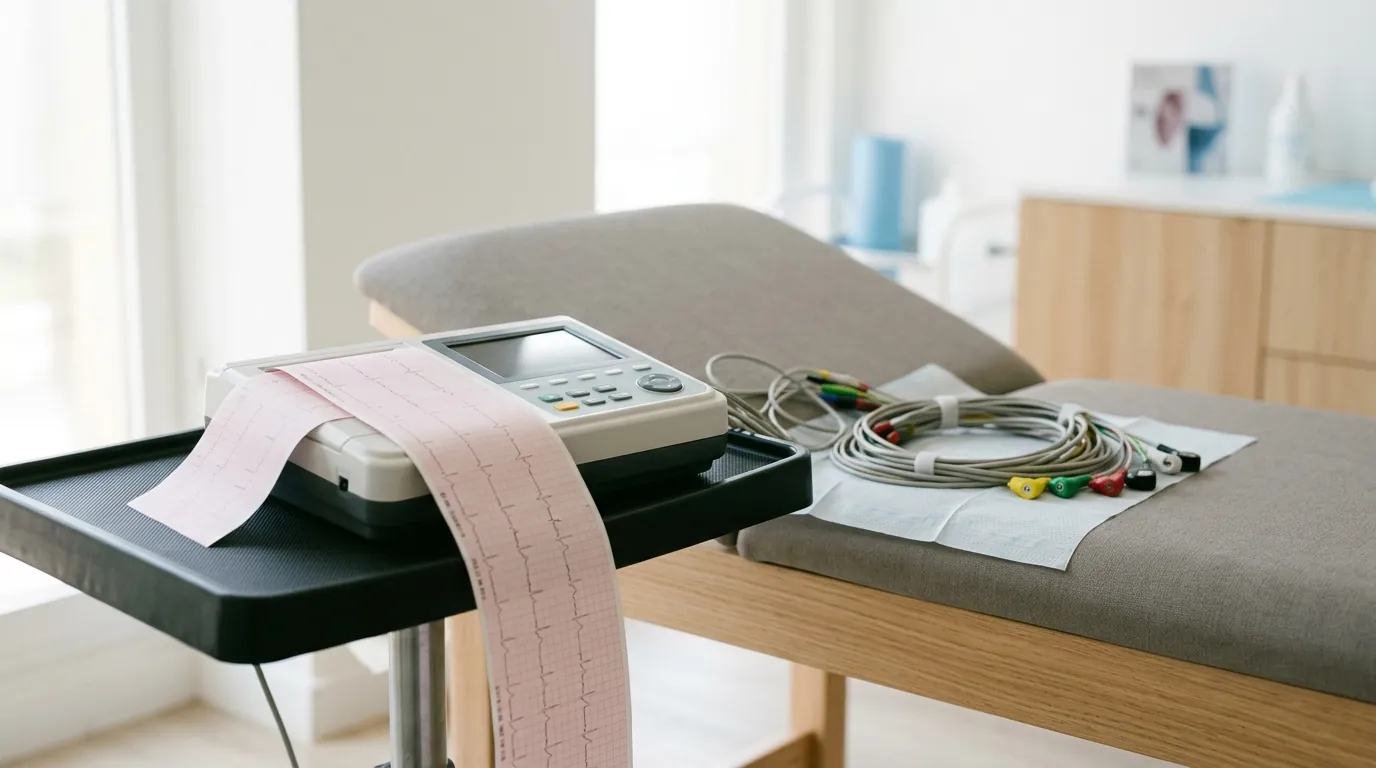
12-lead electrocardiogram: a quick, painless test with no preparation that records your heart's rhythm and helps rule out problems.
What it is and what it's for
An electrocardiogram records the heart's electrical activity. Electrodes are placed on your chest, wrists and ankles, and the trace is obtained within minutes. It's painless, uses no radiation and needs no preparation.
It's used to assess rhythm and rate, detect arrhythmias, spot signs of chamber enlargement and pick up changes that point to how well the heart muscle is being supplied with blood.
When it's done
- Palpitations, a fluttering feeling or an irregular heartbeat.
- Chest pain, breathlessness or fatigue on exertion.
- Dizziness or loss of consciousness.
- Before surgery or as part of a medical check-up.
- Monitoring high blood pressure, cholesterol or diabetes.
- Before starting serious sports training.
Its limits
An electrocardiogram is a snapshot of the moment. If the problem comes and goes — an arrhythmia that appears and disappears — a normal trace doesn't rule it out: that's what the 24-hour Holter monitoris for. And if what needs seeing is the heart's structure, the valves or its pumping strength, you need an echocardiogram.
Who interprets it
The trace is read by the cardiologist alongside your history, examination and medication. An ECG «with some abnormality» isn't necessarily bad news, just as a normal one doesn't always close the case: what gives the test its value is the cardiology around it.
Frequently asked questions
Is any preparation needed for an electrocardiogram?
None. You do not need to fast or stop any medication. Electrodes are placed on the chest, wrists and ankles, you are asked to stay still for a moment and within a few minutes it is done. It is painless and emits no radiation: the device only records the heart's electrical activity.
If the ECG is normal, does that rule everything out?
Not entirely. The electrocardiogram is a snapshot of the moment: if the problem appears intermittently, such as an intermittent arrhythmia, it may not coincide with the test, and that is what the 24-hour Holter is for. And if what needs to be seen are the valves or the pumping strength, an echocardiogram is required.
Can I have one before I start playing sport?
Yes, and it is one of its most sensible indications. Before starting a demanding activity or joining a federation, a cardiology assessment with an electrocardiogram helps detect abnormalities that are worth knowing about. Depending on age, family history and the sport, other tests are added.
What is detected on an electrocardiogram?
The heart's rhythm and rate, arrhythmias, signs of enlargement of the chambers, disturbances of electrical conduction and changes that point to the blood supply of the heart muscle, including old heart attacks. What it does not show is the structure or how the heart pumps: that is what the echocardiogram is for.
What should you avoid doing before an electrocardiogram?
Very little: there is no need to fast or to stop any medication. It is best to avoid intense exercise just beforehand, not to apply creams to your chest —they interfere with electrode contact— and to come in comfortable clothing. During the recording you need to stay relaxed and still, because muscle tremor adds noise to the tracing.