
Tratamientos
Published on
Rotator cuff tears and shoulder replacement: when is shoulder surgery needed?
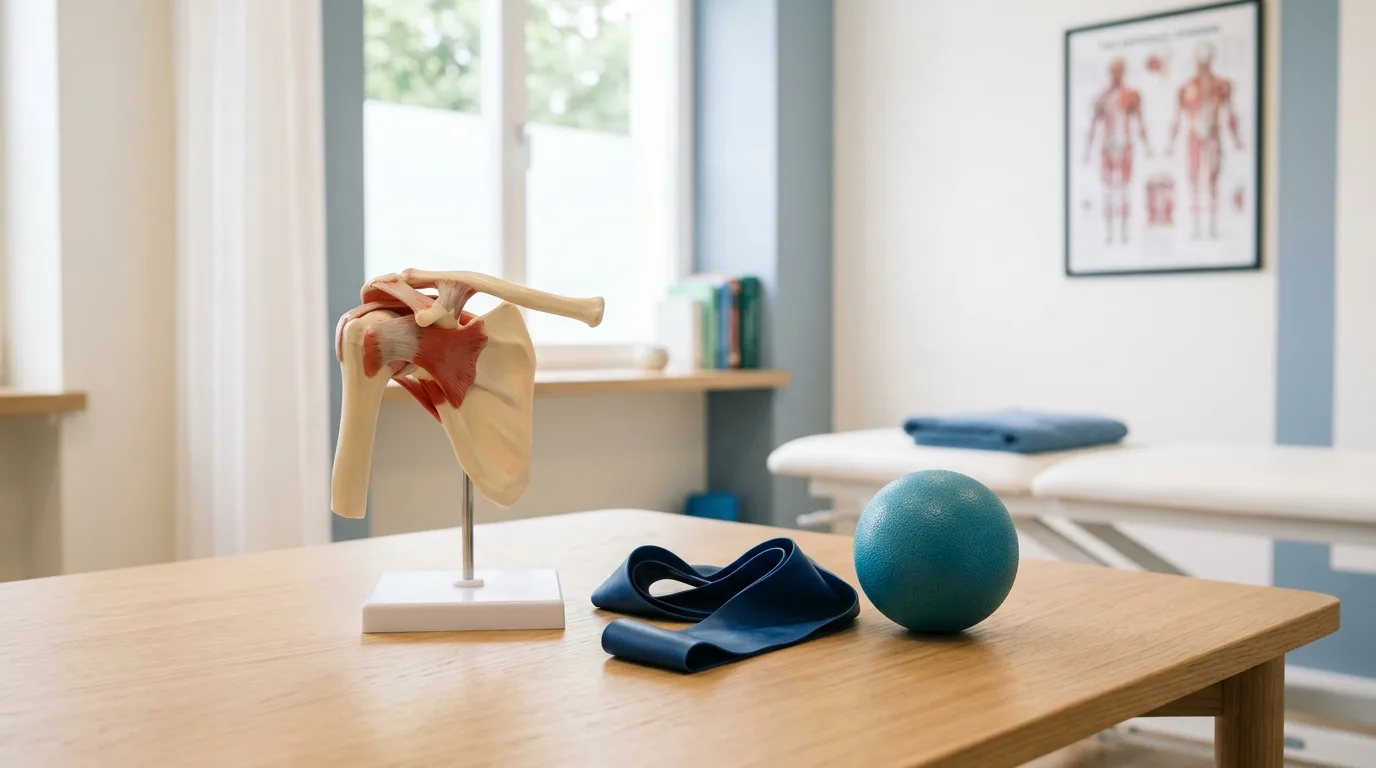
Degenerative and traumatic rotator cuff tears, non-surgical care, arthroscopic repair, anatomic or reverse shoulder replacement: indications and recovery.
The shoulder is the most mobile joint in the body, and that freedom comes at the price of fragility. From the age of 50, shoulder pain that stops you sleeping on that side, brushing your hair or reaching up to a shelf almost always has the same source: the tendons of the rotator cuff. And when the problem lies not in the tendons but in worn cartilage, a shoulder replacement is an increasingly common solution with good results.
This article explains the two shoulder operations most often performed today, arthroscopic rotator cuff repair and total shoulder replacement, and above all when they are needed and when they are not.
The rotator cuff: what it is and why it tears
The rotator cuff is a group of four tendons that wrap around the head of the humerus and keep it centred in the joint as the arm moves. They work every time we reach above our head, in a narrow space under the acromion, where they wear over the years.
There are two ways to injure it:
- Degenerative tear: the most common. The tendon gradually frays over the years until part of it, or its full thickness, tears. Many people over 60 have rotator cuff tears that do not hurt; they are an incidental finding on an ultrasound or MRI scan, not a disease in themselves.
- Traumatic tear: a fall onto the arm, a sudden pull, a dislocated shoulder. The tendon, healthy until then, tears all at once. The person feels intense pain and, above all, a clear loss of strength when lifting the arm.
Common symptoms of a rotator cuff tear: pain on the outer side of the shoulder that runs down the arm, night pain that wakes you when you turn over, difficulty raising the arm or reaching behind your back, and a feeling of weakness. A painful shoulder has other causes too (calcific tendinitis, bursitis, frozen shoulder, osteoarthritis), which are told apart during the examination and with an ultrasound or MRI scan.
Non-surgical treatment of rotator cuff tears
For degenerative tears, and for partial ones, treatment starts without surgery, and for many people it ends there:
- Physiotherapy under supervision for at least three months: regaining movement, and strengthening the remaining healthy tendons and the shoulder blade muscles so that the shoulder works better with what it has.
- Medication to relieve pain and inflammation during painful phases.
- Corticosteroid injection into the subacromial space, which relieves pain and makes physiotherapy possible. It is used sparingly, because repeated steroid injections weaken the tendon. Injections and platelet-rich plasma have a role in selected tendinopathies.
A rotator cuff tear does not heal on its own, but a shoulder with a tear can work well and without pain if the remaining muscles make up for it. That is the aim of non-surgical treatment.
When does a rotator cuff tear need surgery?
- Traumatic tears in active people: as soon as possible, because the tendon retracts and the muscle wastes over time, and a late repair has a poorer result.
- Symptomatic full-thickness tears where three to six months of properly followed non-surgical treatment have not controlled the pain or restored function.
- Younger people, or those with high demands at work or in sport.
In older people with very large, long-standing tears where the muscle has already degenerated, repair may not be possible, and other options are considered, including the reverse shoulder replacement we describe below.
Arthroscopic rotator cuff repair
It is done through three or four incisions of less than a centimetre, with a camera and fine instruments. The torn tendon is reattached to the bone with anchors (small implants inserted into the humerus, carrying suture threads). During the same procedure the space under the acromion can be widened, or the biceps tendon treated if it is damaged.
It is done as a day case or with one night in hospital, under general anaesthetic combined with a nerve block that leaves the arm numb for the first few hours.
Recovery
This is the part that most needs to be respected. The tendon takes months to bond to the bone, and moving it too soon can undo the repair.
- From the third month: progressive strength work.
- Between six and twelve months: final result. Pain improves much sooner; strength takes longer.
Most people end up pain-free and with good function. The main risk is that the tendon does not heal or tears again, which is more likely with large tears, in older people, in smokers and when the timescales are not respected. Even so, many shoulders with a partial re-tear work well and without pain.
Shoulder replacement
When what hurts is not the tendon but the worn joint, the problem is a different one, and so is the solution. A shoulder replacement replaces the damaged joint surfaces. It is mainly indicated for:
- Advanced shoulder osteoarthritis with pain that does not respond to non-surgical treatment.
- Rotator cuff tear arthropathy: shoulders with a long-standing massive tear in which the head of the humerus has moved upwards and destroyed the joint.
- Complex fractures of the head of the humerus in older people, when the bone does not allow reliable fixation.
- Necrosis of the humeral head and inflammatory arthritis.
Two types of shoulder replacement
Choosing the right one is the key to the result:
- An anatomic shoulder replacement reproduces the normal shape of the shoulder: a metal ball on the humerus and a polyethylene cup on the shoulder blade. It needs an intact rotator cuff to move it. It is the option for osteoarthritis with healthy tendons.
- A reverse shoulder replacement changes the geometry: the ball is placed on the shoulder blade and the cup on the humerus. With this design, the deltoid muscle can lift the arm even when the rotator cuff no longer works. It is the option for rotator cuff tear arthropathy, for many complex fractures and for revision surgery.
The operation and recovery
It is worth having realistic expectations: the main aim of a shoulder replacement is to relieve pain and restore useful movement for daily life (brushing your hair, getting dressed, reaching your head and your back). It is not designed for lifting heavy weights or for strength sports, and with a reverse replacement, rotation of the arm may remain somewhat limited.
The risks are those of any joint replacement surgery: infection, dislocation, loosening over the years and nerve injury, all uncommon. Results at ten years are good in the vast majority of cases, and the replacement can be revised if needed.
If your shoulder hurts
A shoulder that hurts at night, has suddenly lost strength after a fall, or has not improved after a few weeks deserves an assessment. At Rincón Salud Orthopaedics we examine the shoulder, investigate it with ultrasound or MRI depending on the case, and plan treatment in stages. When surgery is needed, it is done arthroscopically whenever possible. You can book an appointment with our team.
Frequently asked questions
My ultrasound shows a rotator cuff tear. Do I need surgery?
Not necessarily. If the tear is degenerative and the shoulder responds to physiotherapy, surgery is not indicated. We operate on the shoulder that hurts and does not improve, not on the scan.
How long will I be off work?
It depends on your job. For office work, a few weeks after rotator cuff repair; for jobs involving lifting or working with your arms raised, between four and six months. After a shoulder replacement, the timescales are similar.
Will I be able to sleep on that side?
After rotator cuff repair, once the tendon has healed, yes. It is one of the improvements patients appreciate most.