Consejos
Published on
How to check your breasts: breast self-examination and which changes to get checked
How to check your breasts step by step: when to do it, why breasts change with your cycle, which changes to report and why it does not replace a mammogram.
Breast self-examination helps you know what your breasts are like and notice any change early, but it does not replace a mammogram. It is no longer recommended as a screening method, that is, as a test to look for cancer in women who have no symptoms: that is what mammograms are for. What is advised is getting to know your body and seeing a doctor without delay if something changes. Here is how to check your breasts calmly and which changes are worth an appointment.
What breast self-examination is for (and what it is not)
For years, women were taught to feel their breasts every month following a strict technique, as if it were an exam. Studies that followed many women over several years did not find that this routine, on its own, reduced deaths from breast cancer. It did, however, lead to more women having biopsies (taking a small sample of tissue) for lumps that later turned out to be benign, with all the worry that involves.
That is why today there is more talk of knowing your breasts than of examining them with a rigid method. The idea is simple: if you know their usual shape, feel and appearance, you will find it easier to notice something new. You do not need a perfect technique or to feel that you have to «find» something. And if you forget one month, it does not matter.
What self-examination does not do is replace a mammogram. A mammogram can detect lesions before they can be felt with the fingers, and it is the test that screening programmes are based on.
How to do a breast self-examination step by step
If you want to do it in an orderly way, this is a useful routine:
- Choose the moment. If you have periods, the best time is about 3 to 5 days after your period starts, when your breasts are usually less tender. If you no longer have periods, choose the same day each month so you remember.
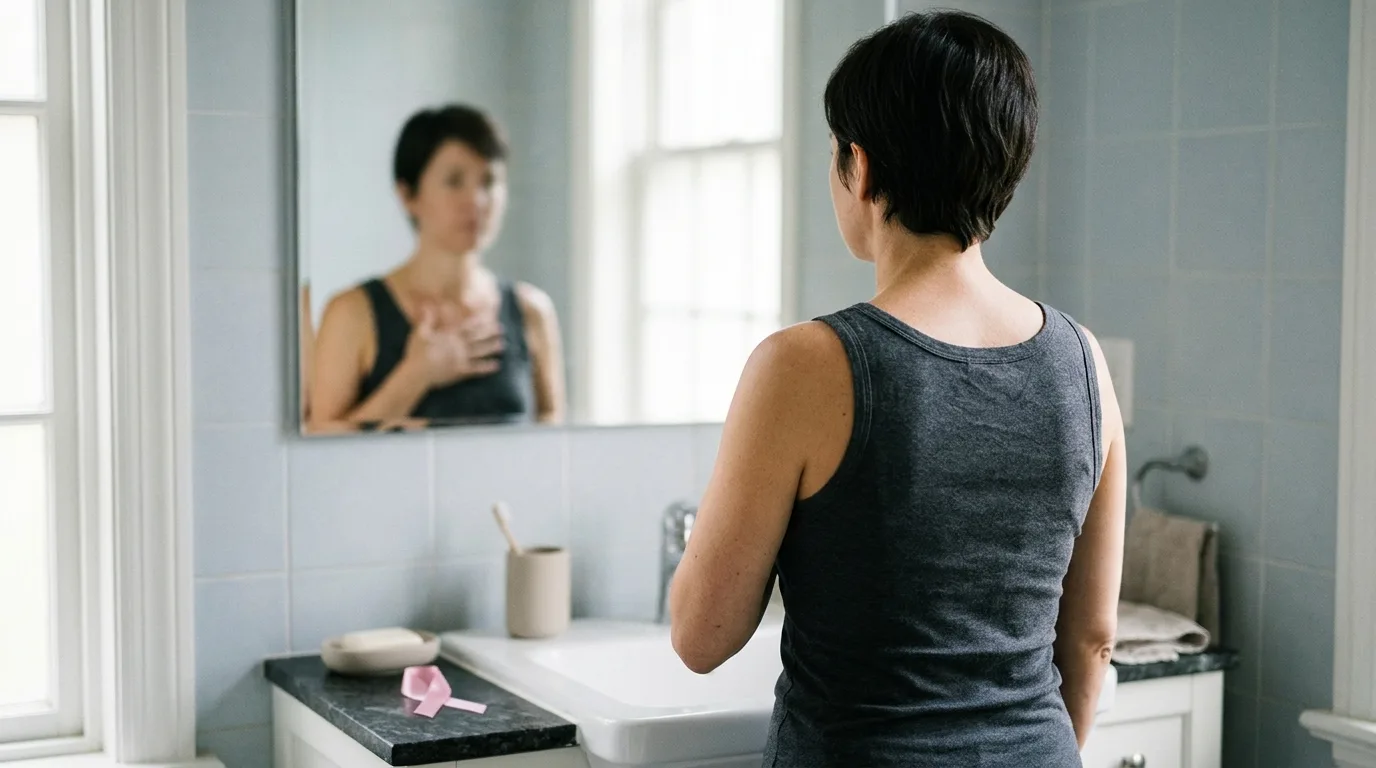
- Look in the mirror. With your arms by your sides, look at the shape, outline and skin of each breast, and at whether either nipple has turned inwards. Repeat with your arms raised above your head.
- Feel while lying down. On your back, with your right hand behind your head, use the pads of the three middle fingers of your left hand to go over the whole of your right breast with small movements, pressing gently but firmly. Always follow the same route so you do not miss any area.
- Do not forget your armpit. Sitting or standing, feel your armpit too.
- Check your nipple. Squeeze it gently to see whether any fluid comes out.
- Repeat on the other side, switching hands.
It is common for breasts not to feel completely smooth and to have lumpier areas, especially before a period. What matters is anything that changes from what is normal for you.
Why your breasts change over the month
Many women notice their breasts are more swollen, tender or lumpy in the days before a period, and better once the period starts. This is usually due to what are called fibrocystic changes, a benign condition that does not increase the risk of breast cancer. Cysts are also common: small sacs of fluid that feel like a soft grape. So are fibroadenomas, benign lumps that feel rubbery and move easily under the fingers.
That is why it is best to always check at the same point in your cycle: that way you compare your breasts in a similar state and do not get alarmed by a change that is only hormonal.
Which breast changes should be checked without waiting
Most breast lumps are not cancer. Even so, any new change deserves to be seen by a professional, and there is no need to wait for your next check-up. Book an appointment if you notice:
- A lump or a harder area in your breast or armpit that was not there before.
- Changes to the skin: dimpling, puckering, sunken areas or an orange-peel appearance, with visible pores.
- Changes in the shape or outline of a breast.
- A nipple that turns inwards when it did not before.
- Nipple discharge, especially if it contains blood or comes from only one nipple.
- A bruise on your breast without having knocked it.
Noticing one of these changes does not mean you have cancer: they can be due to cysts, an infection or other benign problems. But the only way to know is with an examination and, if needed, imaging tests.
What happens when you see a doctor about a breast change
The professional will ask how long you have noticed the change, whether it varies with your period and whether there is a family history, and will examine your breasts and armpits. Depending on what they find and your age, they may request a breast ultrasound, which uses sound waves and helps tell whether a lump is a cyst (a sac of fluid) or something solid, a mammogram, or both. If an image needs confirming, they may suggest a breast biopsy.
Being asked to have another test is not a bad sign: often it is just to rule things out.
Self-examination and mammograms: how they complement each other
In Spain, the public screening programme invites women aged 50 to 69 to have a mammogram, generally every two years. In October 2026, the Ministry of Health and the regional governments approved the plan to extend it to women aged 45 to 74: it still has to come into force and, when it does, each region will bring it in at its own pace over several years. In the meantime, you will receive a letter when it is your turn under your region's programme. If there has been breast cancer in your family, mention it to your doctor: they will assess your risk and whether any extra monitoring or tests would be advisable.
Knowing your breasts and attending screening when it is your turn are two different things that add up: self-examination helps you notice a change between one mammogram and the next; a mammogram can find what cannot yet be felt.
If you notice something new, mention it to your doctor without waiting. If you are unsure when to start your check-ups, you can raise it at your gynaecological check-up, and on the page of our Breast Unit you will find more information about breast tests.
Frequently asked questions
How often should I check my breasts?
There is no set frequency. If having a routine helps, once a month and always at the same point in your cycle is a convenient pattern. What matters is knowing what your breasts are like, not following a strict calendar.
I have noticed a lump just before my period: what should I do?
Before a period it is common for the breasts to be more swollen and lumpy because of hormonal changes. If the lump is new, get it checked; and if it is still there after your period, do not ignore it.
If I check my breasts every month, can I skip my mammogram?
It is not advisable. A mammogram can detect lesions before they can be felt. Self-examination and mammogram screening complement each other; one does not replace the other.
Do I have to wait for my screening appointment if I notice a change?
No. Screening is for women without symptoms. If you notice a lump, a change in the skin or nipple or a discharge, book an appointment with your doctor without waiting for the programme's letter.
Based on reliable sources
Prepared by our team from the references listed below. This is general information and does not replace a consultation.
Article pending review by one of our doctors.
References (7)
- Bartolome-Moreno C, Navarro-Soriano J, Melus-Palazón E. Revisión de la autoexploración mamaria y autoconciencia mamaria. Aten Primaria. 2026;58:103435 Open
- MedlinePlus en español: Autoexamen de mamas Open
- MedlinePlus en español: Protuberancias en las mamas Open
- Ministerio de Sanidad (23-oct-2026): El Consejo Interterritorial aprueba ampliar el cribado de cáncer de mama a las mujeres de 45 a 74 años Open
- Asociación Española Contra el Cáncer (AECC): Mamografías. Diagnóstico precoz del cáncer de mama (revisado en 2023) Open
- Servicio Andaluz de Salud: Detección precoz del cáncer de mama (actualizado el 3-oct-2025) Open
- MedlinePlus en español: Cáncer de mama Open