
Breast ultrasound
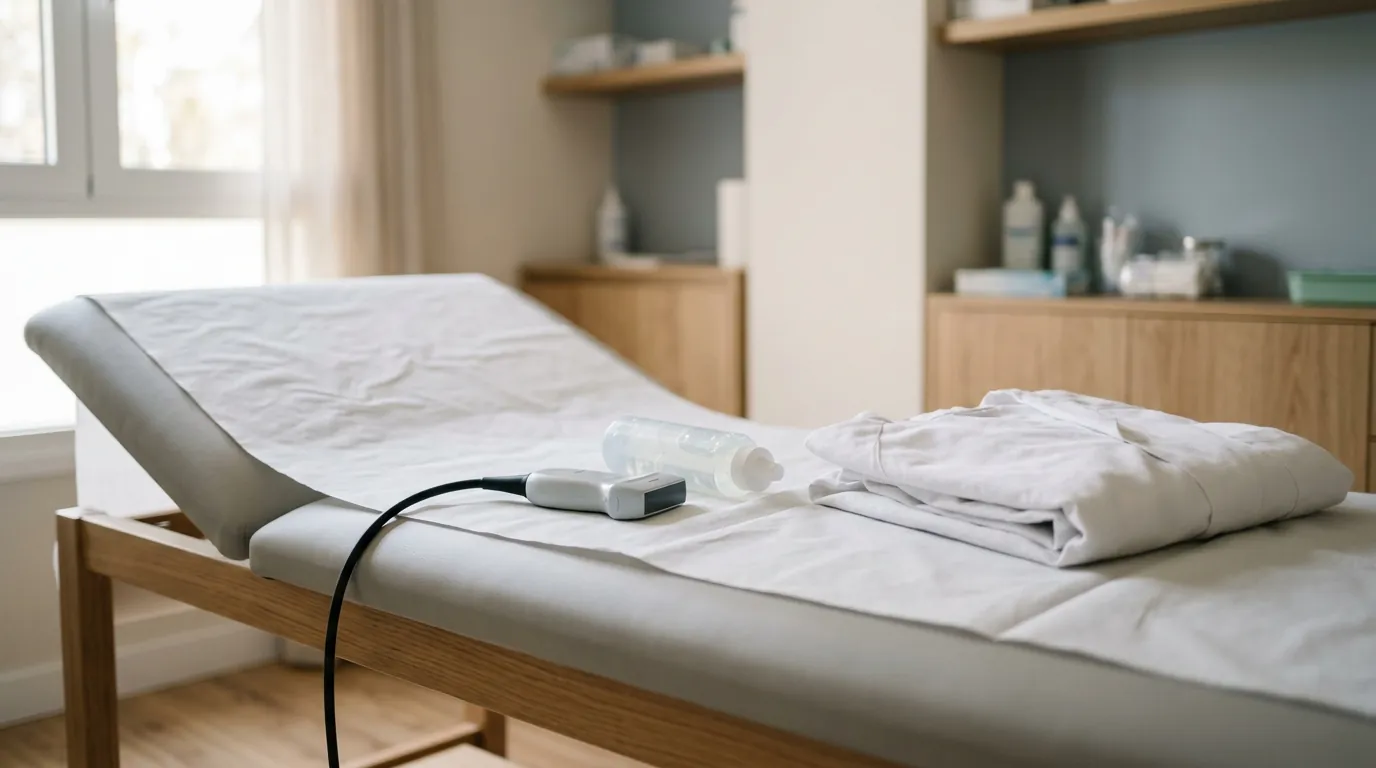
Breast ultrasound: a radiation-free test that distinguishes cysts from solid nodules, indicated for dense breasts, young women and during pregnancy.
What it provides
Ultrasound uses sound waves, without radiation, and is particularly good at two things: distinguishing a cyst —fluid-filled and almost always benign— from a solid nodule, and examining dense breasts, in which mammography loses sensitivity. It also allows the axilla to be examined and can guide a biopsy in real time.
When it is indicated
- Palpable lump at any age.
- Young women, in whom breast tissue is usually dense.
- Pregnancy and breastfeeding, where it is the test of choice.
- As a complement to a mammogram when a finding needs to be clarified or the breast tissue is dense.
- Localised pain, mastitis, discharge or monitoring of a known nodule.
- Evaluation of breast implants and the axilla.
What to expect
You lie down with your arm above your head, warm gel is applied, and the radiologist moves the probe over the breast and axilla. It takes between ten and twenty minutes, is painless and requires no preparation: there is no need to fast or avoid deodorant.
It does not replace mammography
They are complementary tests, not alternatives. Ultrasound does not reliably detect microcalcifications, which are sometimes the first sign of an early tumour and are visible on a mammogram. For this reason, in screening from a certain age, mammography remains the reference test and ultrasound is added when indicated. Any uncertain finding is evaluated in the Breast Unit.
Frequently asked questions
Can an ultrasound scan replace a mammogram?
No. They are complementary: ultrasound does not detect microcalcifications well, and these are sometimes the first sign of an early tumour. In screening from a certain age onwards, mammography remains the reference test and ultrasound is added when indicated.
When is a breast ultrasound requested?
With a palpable lump at any age, in young women with dense breasts, during pregnancy and breastfeeding —where it is the test of choice—, to clarify a mammogram finding, and to study localised pain, mastitis, discharge or implants.
Is any preparation needed?
None. There is no need to fast or to avoid deodorant. You lie down with your arm above your head, warm gel is applied and the breast and armpit are examined for ten to twenty minutes. It does not hurt and involves no radiation.
What can a breast ultrasound detect?
It tells cysts apart from solid nodules, assesses their features, examines the armpit and detects collections or mastitis. It is especially useful in dense breasts and in young women. What it does not show well are microcalcifications, which mammography does reveal.
When is a breast ultrasound performed?
With a palpable lump at any age, during pregnancy and breastfeeding, to clarify a mammogram finding, in dense breasts, with localised pain, discharge or suspected mastitis, and to guide a biopsy when one is needed.
Questions and comments
Ask the specialist who reviews this page or leave us a comment. Everything is reviewed before it is published.
To write, first confirm your email: we will send you a code.
Content reviewed by Ms Concha Soler Blanca