
Tratamientos
Published on
Knee arthroscopy: ligament and meniscus injuries, and which ones need surgery
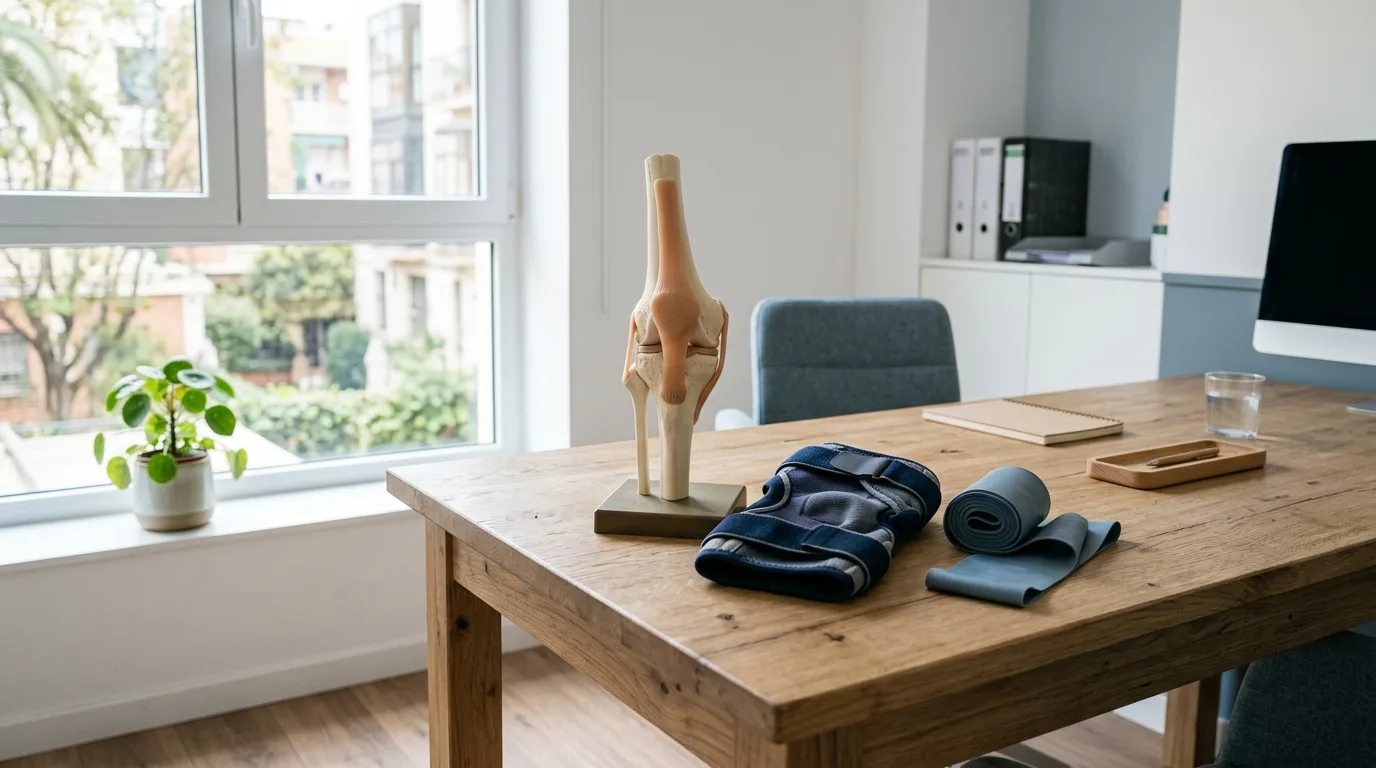
Traumatic and degenerative meniscus tears, ACL tears and combined injuries: which heal without surgery, which need knee arthroscopy and how recovery goes.
Landing awkwardly playing football, a twist while skiing, a pop as you turn with your foot planted. Injuries to the ligaments and menisci of the knee are common in active people of any age, and many of them are now treated by knee arthroscopy: keyhole surgery through two or three small incisions, guided by a camera, that allows the damaged structures to be repaired or reconstructed with a faster recovery than open surgery.
But not every tear needs an operation. In this article we explain what these injuries are, which ones are operated on, which ones are not and what the road back to activity looks like.
What is inside the knee
The menisci are two crescent-shaped pads of fibrocartilage, one on the inner side and one on the outer side, that spread the load between the femur and the tibia and stabilise the knee. The cruciate ligaments (anterior and posterior) cross in the centre of the joint and stop the tibia from sliding forwards or backwards. The collateral ligaments (medial and lateral) hold the knee steady against forces from the side.
When an injury affects several of these structures at once, we call it a complex injury. The best known combines a tear of the anterior cruciate ligament, the meniscus and the medial collateral ligament, and is typical of pivoting sports.
Meniscus injuries
Two very different types
This is the most important distinction, because it completely changes the treatment:
- Traumatic tear, in a young person, after a specific twist or hyperflexion. The meniscus was healthy and tears through a clear mechanism. It hurts, the knee swells over the following hours and sometimes it locks.
- Degenerative tear, in a person over 45 or 50, with no injury or only a minimal one. The meniscus has worn down over the years, often along with the cartilage. It is a very common finding on MRI scans at that age, and it is often not the cause of the pain.
When does a torn meniscus need surgery?
In traumatic tears in young people, especially if the tear is in the peripheral zone of the meniscus, which has a blood supply, an arthroscopic meniscal repair is attempted: stitching the meniscus so that it heals and is preserved. Preserving the meniscus protects the cartilage in the long term, which is why it is worth it even though recovery takes longer than after a resection.
When the tear cannot be repaired, only the damaged fragment is removed (partial meniscectomy), leaving as much healthy meniscus as possible.
In degenerative tears, arthroscopy is not the first step. Several high-quality studies have shown that, in middle-aged people with a degenerative tear and no mechanical locking, surgery gives no better results at one year than a programme of exercise and physiotherapy. Surgery is carried out if the knee genuinely locks or if properly conducted conservative treatment over a few months has not worked.
Anterior cruciate ligament injury
The anterior cruciate ligament (ACL) usually tears without contact with anyone: when stopping suddenly, changing direction or landing from a jump with the knee badly aligned. The person feels a pop, the knee swells within a few hours and, once the acute phase has passed, they feel it give way when turning or going down stairs.
Does a torn ACL always need surgery?
No. A torn ACL does not heal on its own, but not everyone needs to have it reconstructed. The decision depends on age, activity level, whether the knee gives way in daily life and whether there are associated injuries.
- A young person who plays pivoting sports (football, basketball, padel, skiing) usually needs reconstruction to return to play safely and to protect the menisci from further episodes of giving way.
- A person with a moderate level of activity, no feeling of instability and no associated injuries can do well with a strengthening and rehabilitation programme, keeping surgery in reserve in case instability appears.
What reconstruction involves
The torn ligament is not stitched: it is replaced with a graft from one of the person's own tendons (usually the hamstrings, the patellar tendon or the quadriceps tendon), which is passed through tunnels drilled in the tibia and the femur and fixed in place there. All by arthroscopy. Associated injuries are treated in the same operation: the meniscus is repaired or trimmed and, if needed, the medial collateral ligament is repaired or a lateral reinforcement is added in very unstable knees.
Other ligament injuries
The medial collateral ligament is the one most often injured, and in most cases it heals without surgery with a hinged knee brace and physiotherapy over a few weeks. The posterior cruciate ligament tears less often, typically from a direct blow to the tibia, and many isolated tears are also treated conservatively. Surgery is reserved for combined injuries and for knees that remain unstable.
How they are diagnosed
The history of how the injury happened and the examination in clinic (specific manoeuvres for each ligament and for the menisci) point to the diagnosis in most cases. An X-ray rules out associated fractures. An MRI scan confirms the injury and shows the full picture: which ligaments, which menisci, what state the cartilage is in. With that, surgery is planned when it is needed.
What to expect from knee arthroscopy
- ACL reconstruction: the timeline described above, with a return to sport at around nine months.
The risks are low, but they exist: infection, thrombosis, stiffness and, in ligament reconstruction, the possibility of a new tear, especially in very young athletes who go back too soon.
When to see a doctor
A knee that swells in the hours after a twist or a fall, that locks, that cannot be fully straightened or that gives way when walking should be assessed promptly. The sooner the extent of the injury is known, the better the treatment can be planned, and with meniscal repairs time works against you.