
Consejos
Published on
Do wisdom teeth need to be removed if they don't hurt?
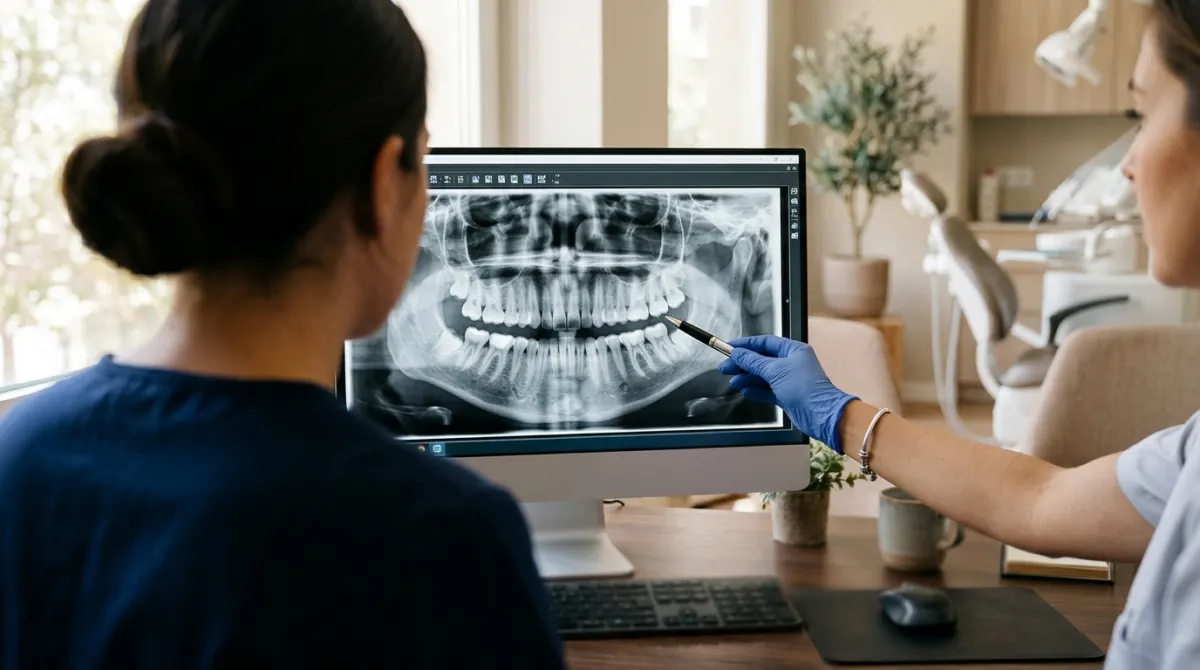
Do wisdom teeth need to be removed if they don't hurt? When extraction is advised, when monitoring is enough and what a panoramic X-ray and 3D scan add.
A wisdom tooth that doesn't hurt doesn't need to be removed for that reason alone, but that doesn't prove it's fine either. The decision depends on its position, whether it can be cleaned and whether it is damaging something you can't feel, such as the tooth next to it. What decides isn't pain, but the examination and the X-ray.
Painless doesn't mean healthy
A wisdom tooth can stay inside the bone or only partly come through and cause no problems for years. In other cases it causes silent damage that only shows up on an X-ray:
- Decay in the neighbouring tooth. When the wisdom tooth sits at an angle against the one next to it, plaque that is hard to clean builds up between them and decay can start on the back of that neighbouring molar, the very tooth you most want to keep.
- Loss of gum and bone around the neighbouring tooth. A wisdom tooth that stays inside could increase the long-term risk of gum disease in that area, although this isn't certain.
- Cysts. The sac around the tooth as it forms can grow and turn into a cyst that takes up bone without causing symptoms.
- Wear on the neighbouring root. Pressure from an impacted tooth can gradually wear away the root of the tooth next to it.
When wisdom tooth removal is recommended even without pain
Clinical guidelines agree that extraction is justified when there is a specific problem, not "just in case". The most common reasons include:
- Decay in the wisdom tooth itself that can't be repaired, or damage to the neighbouring tooth that can't be treated properly while the wisdom tooth is still there.
- A cyst or other lesion around the tooth. In that case, the removal of the cyst is usually done in the same procedure.
- Wear on the root of the tooth next to it.
- Recurrent pericoronitis: infection of the gum that partly covers the tooth. A first mild episode isn't usually enough on its own; when it comes back, extraction is usually the sensible option, even if the tooth doesn't bother you between episodes.
- Some orthodontic treatments or jaw surgery in which the tooth gets in the way of the plan.
On orthodontics, a widespread belief is worth clearing up: that wisdom teeth "push" and twist the front teeth. It hasn't been shown that removing them prevents this crowding. When they are extracted for orthodontic reasons, it is usually because they interfere with a specific movement, and this is assessed case by case.
When it can be monitored
If the tooth is completely covered by bone with no lesions around it, or if it has come through in a good position, bites against the opposing tooth and can be cleaned, the usual approach is to leave it and monitor it. There is no solid evidence that removing healthy wisdom teeth without symptoms brings any benefit, and surgery has its own risks.
Monitoring doesn't mean forgetting about it. It means checking it at your regular visits and repeating the X-ray when the examination justifies it, not according to a calendar. And it means coming in sooner if you notice inflamed gum behind your last molar, a bad taste, difficulty opening your mouth or swelling.
Panoramic X-ray and 3D dental CT scan: what each one adds
The orthopantomogram is the panoramic X-ray that captures your whole mouth in one image. It shows whether the tooth is impacted or has come through, its angle, how much it rests against the tooth next to it, whether there is decay where they touch and whether the space around it is enlarged. It is often enough to make a decision.
The 3D dental scan (dental CT or CBCT) is usually kept for when the panoramic X-ray leaves a question open: above all, whether the roots of a lower wisdom tooth seem to touch the nerve that gives feeling to the lip and chin, or whether an upper one is very close to the maxillary sinus, the hollow space above the upper molars. Seeing that relationship in three dimensions helps to plan the extraction or to conclude that it is wiser to monitor the tooth. It isn't usually requested routinely, because it involves more radiation than a panoramic X-ray.
How the decision is made with the surgeon
It is a shared decision. The professional sets out what the image shows and the risks of operating and of not operating; you bring your general health, how you feel about discomfort and your plans, such as orthodontic treatment or a period when it will be hard to get to the dentist. Useful questions for your appointment:
- What does the X-ray show that justifies removing it, or that allows it to stay?
- What are the risks of extraction in my case, for example because it is close to the nerve?
- If we monitor it, what symptoms should make me come back before the next check-up?
- Would it be done under local anaesthetic, or is sedation an option?
The main risks of removing a lower wisdom tooth are swelling in the first few days, dry socket (the hole doesn't heal properly and is painful) and, less often, tingling or numbness in the lip, chin or tongue if the nerve is affected, which usually improves although it can last weeks or months. If fear of the procedure is what is holding you back, conscious sedation can make it easier to get through.
If you have doubts about your wisdom teeth, the sensible thing is a check-up with an X-ray to find out where they stand. On the wisdom tooth extraction page we explain what the procedure and recovery involve.
Frequently asked questions
If a wisdom tooth hasn't come through, can it come through later on?
It may finish coming through over the following years, especially in young adults, or stay impacted for good. That's why, if it isn't causing problems, it is monitored at check-ups rather than decided in advance.
Is there an age after which they are no longer removed?
There is no age limit. What counts is whether there is a problem that justifies the procedure and the state of your general health. In an older person with an impacted tooth and no lesions, the usual approach is to leave it and monitor it.
I've been told to have it out, but it doesn't bother me. Is that normal?
Yes, if something specific has been seen on the X-ray: decay in the neighbouring tooth, a cyst or a root being worn away. Ask what finding justifies the extraction; you have the right to understand it before deciding.
Based on reliable sources
Prepared by our team from the references listed below. This is general information and does not replace a consultation.
Article pending review by one of our dentists.
References (4)
- NICE TA1. Guidance on the extraction of wisdom teeth (National Institute for Health and Care Excellence) Open
- Cochrane (Ghaeminia et al., 2020). Extracción quirúrgica frente a conservación de muelas del juicio incluidas sin síntomas ni enfermedad Open
- MedlinePlus en español. Diente impactado Open
- NHS. Wisdom tooth removal Open