
Published on
Cancerous moles: the ABCDE rule and when to see a dermatologist
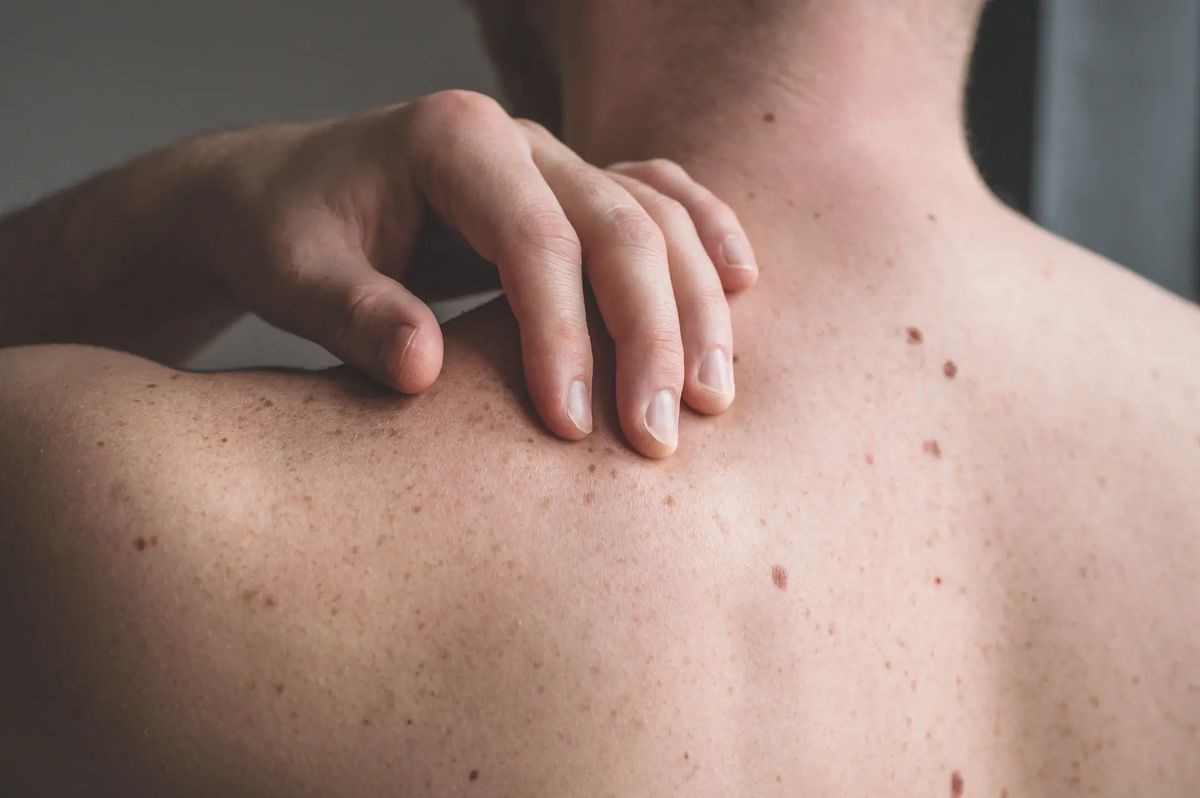
Signs of cancerous moles with the ABCDE rule of melanoma: asymmetry, border, colour, diameter and evolution, when to get one checked and how often.
Most moles are benign, meaning they are not cancerous, and pose no risk to your health. However, some changes in their shape, size, colour or behaviour can indicate that a dermatological check-up is needed.
Looking at your skin regularly helps you spot new lesions or changes in moles you already had. One of the best-known tools for this first look is the ABCDE rule for moles.
This rule doesn't allow you to make a diagnosis at home, but it helps you recognise the signs that justify booking an appointment with a dermatologist
How can you tell if a mole could be cancerous?
It isn't always possible to tell a benign mole from a suspicious lesion just by looking at it. Some changes can seem harmless, while others can be worrying without being malignant.
A proper assessment should be carried out by a professional, especially when a new lesion appears or there is an obvious change.
As an initial guide, it is advisable to pay attention to five features: asymmetry, border, colour, diameter and evolution.
Get in touch and book an appointment
The ABCDE rule for moles
A for asymmetry
A benign mole usually has a fairly even shape. If you drew an imaginary line through the centre, both halves would look similar.
In an asymmetrical lesion, one half can have a clearly different shape from the other. Asymmetry doesn't necessarily mean there is a melanoma, but it is a feature that is worth having assessed.
B for border
Ordinary moles usually have well-defined, regular borders that are easy to tell apart from the surrounding skin.
It's advisable to see a doctor when the borders are:
- Irregular.
- Jagged.
- Blurred.
- Poorly defined.
- Spreading into the nearby skin.
Recent changes in the outline are particularly relevant.
C for colour
A benign mole usually keeps a fairly uniform colour.
A lesion can look suspicious when it has several shades within it, for example:
- Light and dark brown.
- Black.
- Red.
- Pink.
- White.
- Bluish or greyish tones.
You should also keep an eye on a mole that changes colour over time or develops an area that is noticeably darker.
D for diameter
Traditionally, attention is paid to moles with a diameter of more than about six millimetres, roughly the size of the rubber on the end of a pencil.
However, size alone can neither rule out nor confirm a malignant lesion. Some suspicious lesions can be smaller.
That's why diameter should be assessed together with the other features and, above all, with how the mole evolves.
E for evolution
Evolution is one of the most important signs.
It's a good idea to ask for a check-up when a mole:
- Gets bigger.
- Changes shape.
- Changes colour.
- Starts to become raised.
- Becomes harder.
- Causes persistent itching.
- Hurts.
- Bleeds for no obvious reason.
- Repeatedly forms a scab.
- Behaves differently from the others.
A gradual change deserves attention even when the mole doesn't clearly meet the other criteria of the ABCDE rule.
Is an itchy mole dangerous?
Itching can have different causes. A mole can become irritated by clothes rubbing against it, sweat, shaving or a minor injury.
Even so, it's advisable to have it assessed when:
- The itching lasts for several days.
- There is no clear cause of irritation.
- It comes with changes in shape or colour.
- The area bleeds or forms scabs.
- The mole has got bigger.
- The sensation keeps coming back.
Scratching can cause wounds and bleeding, so it's best not to pick at or handle the lesion.
What does it mean if a mole bleeds?
A mole can bleed after a knock, a nick while shaving or constant rubbing from clothing. In these cases there is usually an obvious cause.
However, it should be checked when it bleeds spontaneously, keeps bleeding again and again or shows other changes.
You shouldn't try to remove it at home, cut it off, burn it or apply products meant for removing warts. Before treating any pigmented lesion, it is essential to identify correctly what kind of lesion it is.
Are all black moles cancerous?
No. Some benign moles can be very dark.
A black colour on its own doesn't tell you whether a lesion is dangerous. What matters more is whether it has appeared recently, whether it looks different from your other moles or whether it combines several colours irregularly.
A professional check-up allows the lesion to be examined in more detail and a decision to be made on whether it needs monitoring or testing.
Who should keep a closer eye on their moles?
Anyone can benefit from checking their skin regularly, but monitoring is especially important when certain factors are present.
These include:
- Having lots of moles.
- Having moles of very different shapes or sizes.
- Having a personal history of melanoma or other skin cancers.
- Having close relatives who have had melanoma.
- Having had severe sunburn, especially in childhood.
- Having fair skin, freckles or skin that burns easily.
- Working or spending many hours outdoors doing activities.
- Using, or having used, sunbeds.
How often you have dermatological check-ups should be tailored to each person.
How often should moles be checked?
There is no single frequency that suits everyone.
People with lots of moles, a family history or lesions considered atypical may need scheduled check-ups with a dermatologist.
Between check-ups, it's best to see a doctor without waiting for your next appointment if you notice a new, different or changing lesion.
Get in touch and book an appointment
How does a dermatologist examine a mole?
The appointment begins by looking at the lesion and going over its history: how long it has been there, whether it has changed and whether it causes any symptoms.
The dermatologist may use a dermatoscope, an instrument that makes it possible to examine structures in the skin that can't be seen with the naked eye.
Depending on the findings, they may recommend:
- Regular monitoring.
- Taking photographs to compare how it changes.
- Dermatological check-ups.
- Removing the lesion.
- Sending it to the pathology lab for analysis.
Removal and analysis are the procedures that make it possible to know exactly what a lesion is when there is cause for suspicion.
When to book a dermatology appointment
It's advisable to see a dermatologist in any of these situations:
- A new mole in adulthood that keeps growing.
- A mole that is clearly different from the others.
- Rapid changes in size, colour or shape.
- Irregular or poorly defined borders.
- Several colours within the same lesion.
- Persistent itching or pain.
- Bleeding without any injury.
- A wound that won't heal properly.
- A scab that goes away and comes back.
- A dark mark under a nail with no known cause.
- A lesion that worries you, even if it doesn't meet all the ABCDE criteria.
There's no need to wait for several signs to appear. A single persistent change can be reason enough for a check-up.
Mole checks
At Policlínica Rincón Salud you can book a dermatology appointment to have moles, marks and other skin lesions assessed.
An early check-up makes it possible to determine whether the lesion just needs monitoring or whether a test or treatment is advisable.
The ABCDE rule is useful for getting to know your own skin better, but it doesn't replace medical judgement. When a mole changes, stands out from the others or causes symptoms, the safest option is to ask for a dermatological check-up.
Call us on 900 52 52 84 or contact us through our online form. We'll be happy to book your first session and explain the whole process to you.