
Tratamientos
Published on
Peri-implantitis: what it is, how it is detected and how to prevent it
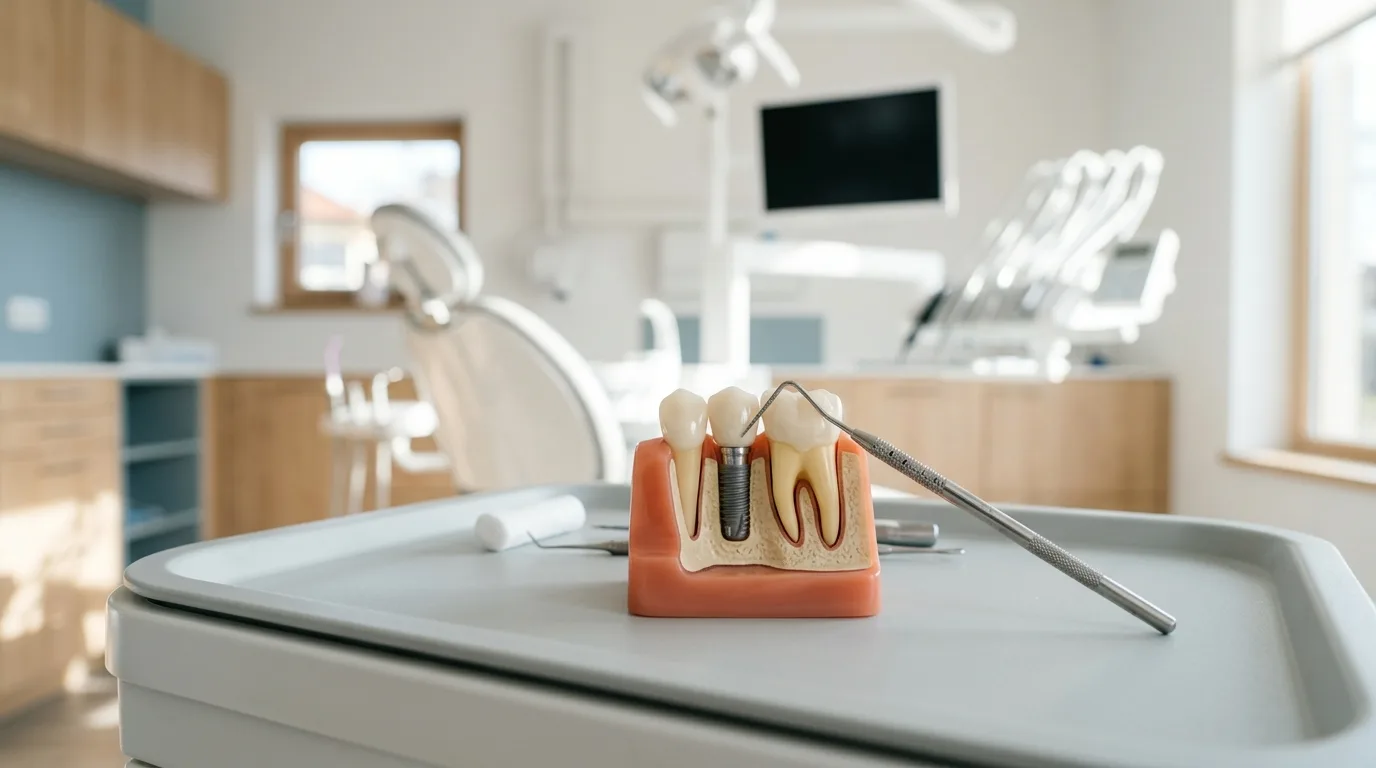
What peri-implantitis is, how it differs from peri-implant mucositis, the symptoms, how it is diagnosed and treated, and the habits that help prevent it.
What is peri-implantitis and how is it different from mucositis?
A dental implant is an artificial root, usually made of titanium, that is fixed to the bone and on which a crown or a prosthesis is placed. We explain this in more detail in what a dental implant is and when it is placed. The implant cannot get tooth decay, but the gum and bone around it can become diseased, almost always for the same reason: the bacterial plaque that builds up around it.
The classification agreed in 2017 by the European Federation of Periodontology and the American Academy of Periodontology distinguishes two stages:
- Peri-implant mucositis. The inflammation is limited to the gum around the implant: it is red, swollen and bleeds when you brush or when it is examined, but no bone has been lost yet. It is the equivalent of gingivitis in a natural tooth and, if the plaque is removed, it can be reversed.
- Peri-implantitis. The inflammation has reached the bone that holds the implant and is gradually destroying it. It is comparable to periodontitis (what used to be called ‘pyorrhoea’) in natural teeth. The lost bone does not grow back on its own and, if the process keeps advancing, the implant may end up working loose.
Mucositis is considered the forerunner of peri-implantitis. That is why the key idea is simple: the sooner the inflammation is detected, the easier it is to stop.
Symptoms: the signs to watch out for
Peri-implantitis usually progresses without pain and is often discovered at a check-up. Even so, there are signs that are worth getting checked:
- Bleeding from the gum around the implant when you brush or use an interdental brush.
- Inflamed gum, red or more sensitive than usual in that area.
- Suppuration: pus coming out when the gum is pressed, often with a bad taste or bad breath.
- Gum recession: the gum shrinks back and the metal edge or the threads of the implant start to show.
- Movement of the implant. This is a late sign: when the implant moves, the bone loss is usually already significant. If it is only the crown that moves, it may be a loose screw, which is a different problem, but it still needs checking.
No pain doesn't mean nothing is wrong. If you notice any of these signs, the sensible thing is to book an appointment without waiting for your next check-up.
Causes and risk factors
The cause is the bacterial plaque that builds up around the implant, especially where it meets the gum and below the gumline. But not everyone has the same risk. According to the 2017 consensus mentioned above, the factors that weigh most heavily are:
- Having had periodontitis. People who lost teeth to gum disease are more prone to inflammation of the tissues around the implant as well. That is why periodontitis should be under control before implants are placed, and should continue to be monitored afterwards.
- Insufficient hygiene around the implant, often because the prosthesis is difficult to clean or the right brushes are not being used.
- Not attending professional maintenance once treatment has finished.
There are other factors associated with gum problems, although studies do not yet allow us to measure precisely how much they influence peri-implantitis:
- Smoking, which weakens the gum's defences and healing and also masks bleeding, one of the first warning signs.
- Poorly controlled diabetes, which encourages inflammation and infections in general.
- Cement remnants under the gum with some cemented crowns, or implants in positions that are difficult to clean.
Then there is bruxism (clenching or grinding your teeth), which deserves a separate mention. Rather than causing the infection, it puts the implant and the prosthesis under excessive forces that can loosen screws or break the ceramic. If you clench your teeth, your dentist may recommend a night guard to protect the work.
How it is diagnosed: probing and X-rays
Diagnosis is made in the clinic with two simple tests:
- Probing. Using a fine probe, and gently, the dentist measures the depth of the groove between the gum and the implant and checks whether it bleeds or produces pus. A pocket that is deeper than at previous check-ups, with bleeding or pus, is a warning sign.
- X-ray. This shows the level of the bone around the implant. After placement, a small amount of initial bone remodelling is normal; what points to peri-implantitis is bone loss that keeps progressing over time.
That is why the baseline measurements and X-rays taken at the end of treatment are so valuable: they are used for comparison at later check-ups. If you have had implants for years and don't have that record, your first check-up will serve as the starting point.
Peri-implantitis treatment according to the stage
Treatment depends on how far the disease has progressed, and no result can be promised in advance: the amount of bone lost, the shape of the defect, the type of implant and prosthesis and each person's risk factors all play a part. The clinical guideline published in 2023 by the European Federation of Periodontology proposes a step-by-step approach.
If it is mucositis
The surface of the implant and the surrounding gum are cleaned thoroughly, the prosthesis is checked to make sure it allows proper hygiene, and we go over your home cleaning techniques with you. At this stage, with consistency, the inflammation can settle.
If it is peri-implantitis
- First step, without surgery: deep cleaning of the area, control of the risk factors (hygiene, smoking, diabetes) and, if needed, changes to the prosthesis so that it can be cleaned.
- Surgery when the inflammation persists: the implant is accessed so it can be cleaned and decontaminated directly and, depending on the defect, the bone is reshaped or an attempt is made to regenerate it.
- Removing the implant in the most advanced cases, when it has lost so much support that it is not reasonable to keep it. Later on, the possibility of placing another one is assessed.
In some cases the dentist may add medication as a complement. That decision is made in the clinic, for each patient: self-medicating is not advisable, because an antibiotic taken on your own initiative can ease the symptoms for a few days without tackling the cause.
After treatment, maintenance is even more important, because peri-implantitis can come back if plaque builds up again.
Prevention: hygiene at home, maintenance and check-ups
The best way to treat peri-implantitis is to stop it from developing. Prevention starts before the implant is placed, by treating periodontitis if there is any and planning a prosthesis that can be cleaned, and continues for as long as you have the implant:
- Brushing twice a day, paying attention to where the gum meets the crown.
- Cleaning between your teeth with interdental brushes of the right size or with a water flosser, as advised. Conventional dental floss doesn't always reach properly around the implant.
- Regular professional check-ups and cleaning, at a frequency adjusted to your risk. At these appointments the areas you can't reach at home are cleaned and the gum is measured to detect any change in time.
- Stopping smoking, or at least cutting down, and keeping your diabetes under control if you have it.
- Protecting the implant from bruxism with a night guard, if your dentist considers it necessary.
Full-arch prostheses on implants, such as full-mouth dental implants, need special attention: they have areas that are hard to reach, and it is worth having someone at the clinic show you exactly which brushes to use and how.
If you notice something unusual around an implant
Bleeding, swelling or a bad taste around an implant are not something you have to live with. A check-up will show whether it is mucositis, which usually clears up with cleaning and good habits, or peri-implantitis that should be treated as soon as possible. If you have implants or are thinking of getting them, in our dental implant unit we check their condition and explain how to look after them.
Based on reliable sources
Prepared by our team from the references listed below. This is general information and does not replace a consultation.
Article pending review by one of our dentists.
References (4)
- Berglundh T et al. (2018). Peri-implant diseases and conditions: Consensus report of workgroup 4 of the 2017 World Workshop on the Classification of Periodontal and Peri-Implant Diseases and Conditions Open
- Schwarz F et al. (2018). Peri-implantitis Open
- Herrera D et al. (European Federation of Periodontology) (2023). Prevention and treatment of peri-implant diseases—The EFP S3 level clinical practice guideline Open
- SEPA (Sociedad Española de Periodoncia y Osteointegración) · Cuida tus encías (2021). 6 consejos para prevenir las enfermedades periimplantarias Open