
Tratamientos
Published on
How long do dental implants last? What affects their lifespan
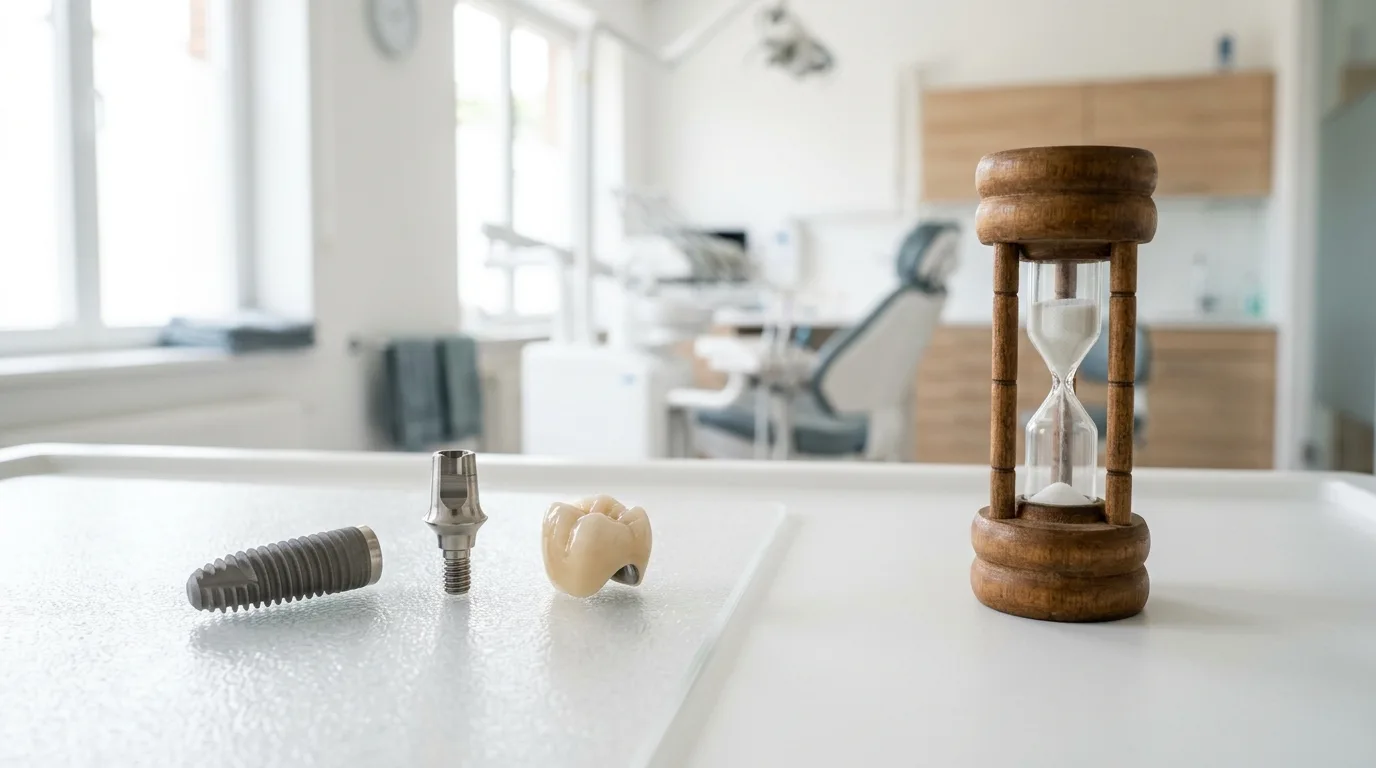
How long dental implants last, why the crown usually needs replacing before the implant, what shortens their lifespan and what maintenance helps them last.
How long the implant lasts and how long the crown lasts: they are not the same
When people ask how long dental implants last, it helps to separate an implant into its parts, because they do not wear in the same way:
- The implant is the artificial root, usually made of titanium, that sits inside the bone. It cannot get decay and does not wear down with chewing. Once integrated, it can stay stable for many years as long as the gum and bone around it remain healthy.
- The abutment and screws connect the implant to the crown. They are small parts that may loosen over time or need replacing.
- The crown or prosthesis is the visible part, the part that does the chewing. It is exposed to wear, knocks and the force of your bite, and it is the part that most often needs repairing or replacing over the years.
In other words: over the life of an implant, it is common to need a new crown without touching the root. If you want to know what that visible part is like and how it is made, we explain it in single implants and implant-supported bridges.
And a specific figure? There isn't one that applies to everyone. A well-planned, well-integrated and well-maintained implant can work for many years, but nobody can guarantee in advance how long any particular one will last. Rather than a number, what is useful is knowing what extends its life and what shortens it.
How long the dental implant process takes: from placement to the final crown
Another common question is how long it takes from the start until you have your final tooth. Broadly speaking, the process has these stages:
- Initial assessment. An examination, X-rays and, usually, a 3D scan to measure the available bone and plan the position of the implant.
- Placing the implant. This is surgery carried out under local anaesthetic, so you should not feel pain during the procedure, although you will feel pressure. Afterwards it is normal to have some discomfort and swelling for a few days, which is kept under control by following the dentist's instructions.
- Integration into the bone. This is the longest stage: it usually takes a few months for the bone to bond with the implant. How long depends on the area of the mouth, the quality of the bone and whether it had to be regenerated first.
- Final crown. Once the implant has integrated, a record of the mouth is taken, nowadays usually with an intraoral scanner, and the crown is made to measure.
In some selected cases, a temporary prosthesis can be fitted shortly after surgery, known as immediate loading, so that you are not left without a tooth while you wait. Whether this is possible in your case is decided by the initial assessment.
What shortens the life of an implant
What tends to fail over the years is not the titanium, but what surrounds it. These are the factors with the greatest influence.
Peri-implantitis
This is inflammation of the gum and bone around the implant, caused by bacterial plaque. It starts as inflammation of the gum, known as mucositis, which can be reversed; if it progresses, it destroys the bone that holds the implant in place. It is one of the main reasons why an implant that has been working for years is lost, and it almost never hurts at first.
Inadequate hygiene
Plaque builds up around an implant just as it does on a tooth. If it isn't removed properly, especially where the gum meets the crown, the gum becomes inflamed.
Smoking
Smoking reduces the blood supply to the gum and its ability to defend itself and heal. It also masks bleeding, which is one of the first warning signs.
Bruxism
Clenching or grinding your teeth, often at night and without realising, puts the implant and the crown under excessive force: it can loosen screws, break the ceramic and overload the bone.
Other factors
A history of gum disease (periodontitis), poorly controlled diabetes or a prosthesis that is difficult to clean also increase the risk. They do not rule out implants, but they call for closer monitoring.
Maintenance and check-ups
Maintenance is not an extra: it is part of the treatment. What helps an implant last most:
- Brushing twice a day, paying particular attention to the gum line.
- Cleaning between the teeth with interdental brushes of the right size or with a water flosser.
- Regular check-ups and professional cleaning. How often is tailored to each person and is usually more frequent if you have had periodontitis, if you smoke or if you have a full-arch prosthesis.
- An occlusal splint (night guard) if you clench your teeth.
At check-ups, the gum around the implant is examined, the crown and screws are checked to make sure they are properly secured and, when it is due, an X-ray is taken to monitor the bone level. That way, problems are picked up before you notice them.
Fixed prostheses that replace a full arch, such as full-mouth implants, also need to be removed at the clinic from time to time so they can be thoroughly cleaned and their components checked.
When the crown or the implant needs replacing
The crown is repaired or replaced when:
- The ceramic has fractured or chipped.
- It is very worn and the bite no longer fits properly.
- There is an aesthetic problem, for example because the gum has changed or the colour no longer matches the neighbouring teeth.
- Its shape makes it hard to clean properly around the implant.
Replacing the crown does not mean replacing the implant: the visible part is replaced and the root stays where it is.
The implant, on the other hand, is only considered for removal when it has lost so much bone that it cannot be saved, when it moves or, in rare cases, when it has fractured. If bone loss is detected in time, it can often be treated without having to remove the implant.
It is a good idea to book an appointment if you notice bleeding or inflammation around the implant, a bad taste, that the crown moves or that your bite feels different.
If you have an implant or are thinking of getting one
How long an implant lasts is largely decided before it is placed, through a careful assessment, and afterwards, through maintenance. If you want to know whether you are a suitable candidate or to have an existing implant checked, on our dental implants page we explain how we work and how to book an assessment.
Based on reliable sources
Prepared by our team from the references listed below. This is general information and does not replace a consultation.
Article pending review by one of our dentists.
References (4)
- Howe MS et al. (2019). Long-term (10-year) dental implant survival: A systematic review and sensitivity meta-analysis Open
- Jung RE et al. (2012). Systematic review of the survival rate and the incidence of biological, technical, and aesthetic complications of single crowns on implants reported in longitudinal studies with a mean follow-up of 5 years Open
- Herrera D et al. (European Federation of Periodontology) (2023). Prevention and treatment of peri-implant diseases—The EFP S3 level clinical practice guideline Open
- SEPA (Sociedad Española de Periodoncia y Osteointegración) · Cuida tus encías (2022). 6 falsas creencias sobre los implantes dentales Open