
Tratamientos
Published on
Types of braces: brackets, clear aligners and how to choose
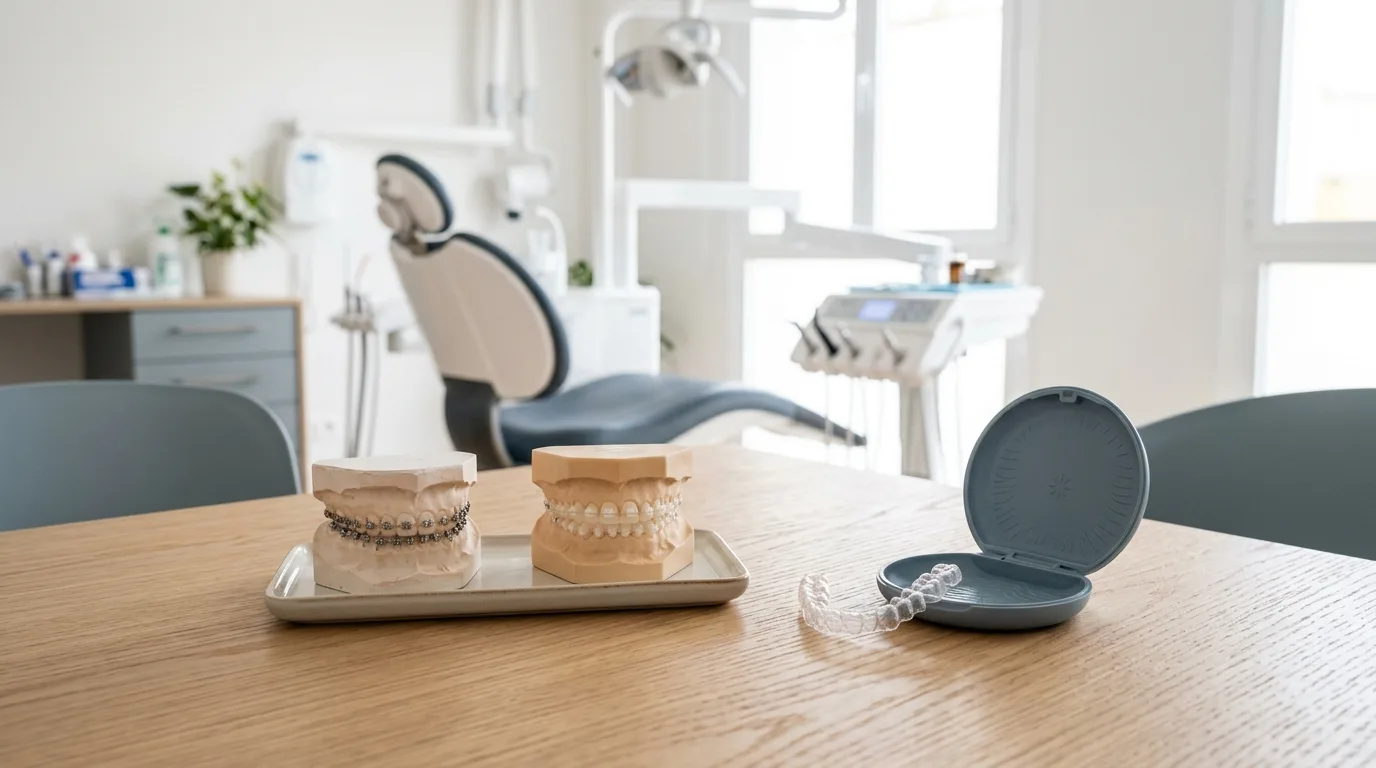
Metal and ceramic braces, clear aligners, lingual braces and children's orthodontics: how the types of braces differ and why the choice is a clinical one.
Fixed braces with brackets
Of all the types of braces, this is the most widely used. Small attachments, the brackets, are bonded to the visible surface of each tooth and connected with an archwire. At check-ups, the orthodontist adjusts or changes that wire, and the force it exerts moves the teeth little by little into the planned position. Because the brace is fixed, it works continuously without relying on the patient remembering to put it in.
Metal braces
These are the traditional ones, made of steel. They are strong, they can treat a wide variety of cases, including complex ones, and they are usually the most affordable option. Their main drawback is that they are visible. You can find more details on our metal braces page.
Aesthetic ceramic or sapphire braces
They work in the same way as metal braces, but they are made of tooth-coloured materials, such as ceramic, or clear ones, such as sapphire, so they are much less noticeable. They are usually combined with wires and ties in discreet shades. They need a little more care with foods and drinks that stain, because the elastic ties can become discoloured. We explain this on our aesthetic braces page.
Invisible orthodontics with clear aligners
Instead of brackets, a series of clear trays is used, custom-made from a digital scan of the mouth. Each aligner moves the teeth a little and is replaced by the next one at set intervals, according to the plan. For them to work, they have to be worn for most of the day and taken out only to eat and to clean your teeth.
Other techniques: lingual and self-ligating braces
There are other types of fixed braces worth knowing about, although not every clinic offers them and they are not suitable for every case:
- Lingual braces. The brackets are bonded to the inner surface of the teeth, the side facing the tongue, so they cannot be seen when you smile. They require a specific technique and, at first, they can rub against the tongue and affect speech slightly.
- Self-ligating braces. Instead of the wire being held with small elastics or fine wire ties, the bracket itself has a small clip that holds it in place. They come in metal and aesthetic versions. They have been credited with advantages such as shorter treatment, but studies comparing them with conventional braces show no clear difference in treatment time. What makes the difference is still the treatment plan.
Orthodontics for children: interceptive treatment and orthopaedics
In childhood, while the bones of the face are still growing, orthodontics can work in a different way. It is not so much about straightening teeth as about guiding growth and correcting certain problems in good time:
- Interceptive orthodontics. It aims to correct or halt a problem in its early stages: a crossbite, a lack of space for the permanent teeth, or habits such as thumb-sucking or mouth breathing.
- Dentofacial orthopaedics. It uses appliances, fixed or removable, that act on the jawbones; for example, to widen a narrow palate or to help the lower jaw develop in a better position.
Orthodontic societies usually recommend a first assessment at around the age of 6 or 7, when baby teeth and permanent teeth are present together. This does not mean the child will need treatment at that point: often it is enough to keep an eye on how things develop and, if needed, start at the right time.
Which type of braces should you choose? The orthodontic assessment decides
Appearance and comfort matter, and it is normal to have preferences. But the type of orthodontic treatment is not chosen like a product from a catalogue: it depends on what needs to be corrected. Before suggesting anything, the orthodontist carries out an assessment that usually includes:
- an examination of the teeth, gums and bite;
- X-rays, usually a panoramic X-ray and a lateral skull X-ray;
- photographs and a scan or impressions of the mouth.
With this information, they assess which movements are needed, whether there is a problem with the position of the jawbones as well as the teeth, how long treatment may take and which techniques can achieve the result. Sometimes there are several possible options, and that is when your preferences do count: discretion, budget, the commitment that aligners demand or how often you will need check-ups. At other times one technique is clearly better suited than the others to that particular case.
Age on its own is not a barrier: adults can have orthodontic treatment too, as long as their gums and bone are healthy. If there is gum disease, it is treated before treatment begins.
Retainers after braces: fixed or removable
When the teeth reach their new position, treatment is not over. Teeth tend to drift back towards where they were, especially in the first few months, and the mouth keeps changing over the years. Retainers are used to maintain the result:
- Fixed retainer. A thin wire bonded behind the teeth, usually the front ones. It cannot be seen and does not rely on you remembering to put it in, but the area needs to be cleaned carefully.
- Removable retainer. A clear tray or an acrylic and wire appliance that is worn mainly at night, as your orthodontist advises.
It is common to combine the two. How long you need to wear them is decided by the orthodontist, and in many cases some form of long-term retention is recommended. Stopping too early increases the risk of the teeth moving again.
If you would like to know which type of orthodontic treatment suits your case, in our orthodontics with braces section we explain what the initial assessment involves and what options you have.
Based on reliable sources
Prepared by our team from the references listed below. This is general information and does not replace a consultation.
Article pending review by one of our dentists.
References (4)
- SEPA (Sociedad Española de Periodoncia y Osteointegración) · Cuida tus encías (2023). Brackets o alineadores transparentes: ¿Qué es mejor para corregir tus dientes? Open
- Čelar A et al. (2013). Systematic review on self-ligating vs. conventional brackets: initial pain, number of visits, treatment time Open
- American Association of Orthodontists (AAO). Orthodontics for Children: Developing a Healthy Smile Open
- Martin C et al. (Cochrane) (2023). Retention procedures for stabilising tooth position after treatment with orthodontic braces Open