
Consejos
Published on
Broken tooth: filling, build-up or crown? How it's decided
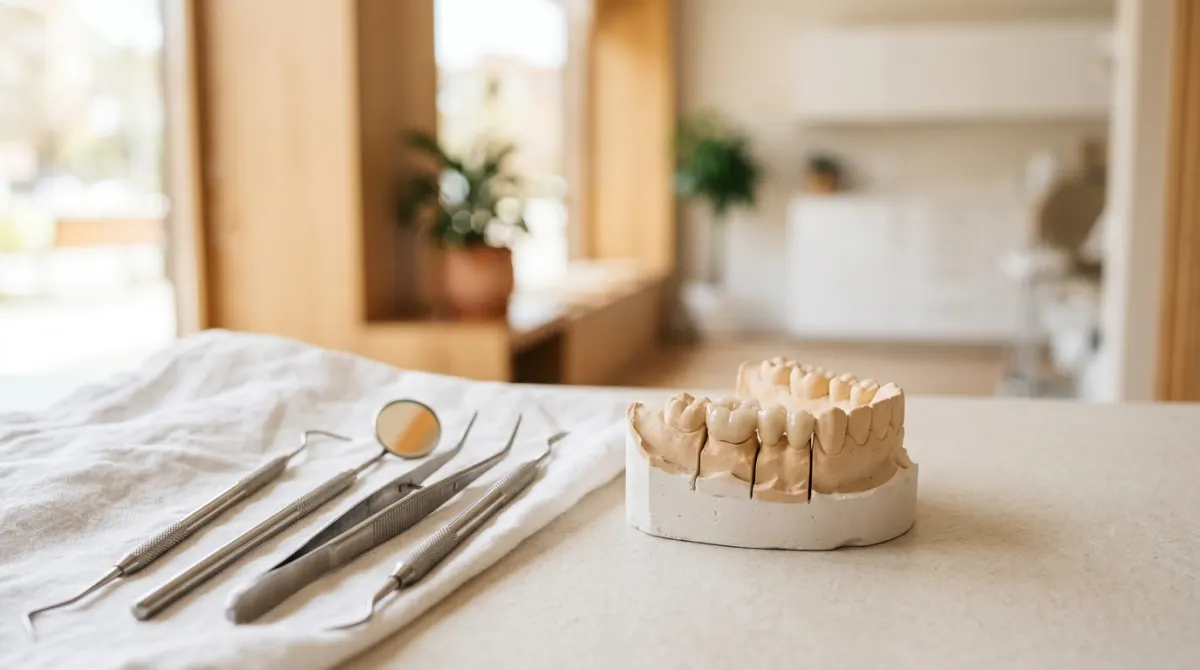
Filling, build-up, inlay or crown: what's assessed when you have a broken tooth, what changes after root canal treatment and what to do until you're seen.
When you have a broken tooth, the repair depends mainly on how much healthy tooth is left, whether the nerve is affected and how much force that tooth has to withstand when chewing. With a small loss, a filling is usually enough; if more is missing, a build-up or an inlay; and if little tooth is left or it has already had root canal treatment, it's often protected with a crown. This is what's assessed in each case and what you can do until you get to the clinic.
If you break a tooth today
- Rinse your mouth with warm water and check for bleeding or a sharp edge.
- If you find the piece, keep it in milk or saline and bring it to your appointment: sometimes, with front teeth, it can be bonded back on.
- Don't chew on that side and avoid hard foods or anything very cold or hot.
- If it hurts, you can take the painkiller you normally use, following the patient leaflet. Don't put aspirin or other products on the gum: they can burn it.
- Book an appointment as soon as possible, even if it doesn't hurt. A broken tooth can keep fracturing, and the less time it spends exposed, the easier it is to save.
Go to dental emergencies the same day if the pain is severe and won't ease, if your face or gum has swollen, if you have a fever, if the tooth has moved or been knocked out, or if you can see a red or bleeding spot in the centre of the fracture. If the blow was hard and there is loss of consciousness, dizziness, vomiting or a wound that won't stop bleeding, call 112.
What the dentist looks at to decide
- How much tooth is left. Losing a corner is not the same as losing one of the points of a back tooth (a cusp) or half the tooth. The fewer healthy walls are left, the more protection the tooth needs.
- Whether the nerve is affected. This is usually checked with an examination, sensitivity tests and an X-ray. If the fracture or deep decay has reached the nerve, root canal treatment is needed first.
- How far the break goes. A fracture that stays above the gum is easier to fix than one that runs down the root.
- Why it broke. Often what gives way is a tooth weakened by decay or by a large old filling. If there is decay, it's removed before the repair. To spot it in time, you may find how to tell if you have tooth decay useful.
- The forces it takes. A back tooth takes a far greater load than an incisor, and clenching or grinding your teeth increases it.
The options, from the simplest to the most protective
Filling
This is the direct repair: the area is cleaned and filled with tooth-coloured composite at the same appointment. It works when a small piece has broken off or a filling has fallen out and the rest of the tooth is strong. It's the most conservative option, because healthy tooth barely has to be touched.
Build-up
When a large part is missing but the tooth still has enough structure, it's also rebuilt with composite, restoring its shape. In teeth with root canal treatment it can be supported by a post placed inside the root. It's a valid solution, although a very large build-up on a back tooth is at greater risk of breaking again than a tooth protected from the outside.
Inlay
This is a custom-made piece, in ceramic or composite, that is cemented into the gap. If it also covers one or more cusps it's called an onlay. It's used when too much structure is missing for a filling, but there are healthy walls worth keeping. It protects the tooth and means less trimming than a crown.
Crown
A crown or cap covers the entire tooth from the outside and spreads the force of chewing. It's considered when little healthy tooth is left, when there are cracks that are best encased or, often, on back teeth with root canal treatment. It requires trimming the tooth and making the crown to measure, with a temporary one in the meantime. We explain the process and materials used in crowns and bridges.
When the fracture runs too far down the root or the tooth is split in two, sometimes it can't be saved. In that case, extraction and how to replace the gap are considered.
If the tooth has already had root canal treatment
A tooth with root canal treatment is usually more fragile, because it has already lost part of its structure to decay or the fracture and to the opening made to reach the canals. Treated back teeth benefit most from cusp protection, whether an onlay or a crown.
While the tooth has a temporary filling, avoid chewing on that side and don't miss the appointment for the permanent restoration: an open or temporarily filled tooth breaks more easily.
When there's no visible break, but it hurts to bite
Some cracks can't be seen with the naked eye. The typical sign is a sharp pain when biting on something particular or when releasing the bite, or sensitivity to cold that comes and goes in the same tooth. It's best to get it looked at soon, because a crack can spread. Depending on how far it goes, the tooth is protected with a restoration covering the cusps or a crown and, if it has reached the nerve, with root canal treatment first. A crown protects a lot, but it doesn't guarantee that the crack won't keep spreading.
To make the repair last
- Brush and clean between your teeth: the edge of any filling, inlay or crown can develop decay again.
- Don't use your teeth as tools or bite on hard objects, such as ice, pens or shells.
- If you clench or grind your teeth, mention it: an occlusal splint can reduce the load on restored teeth.
- Go to your check-ups: that way, worn fillings or leaking edges are detected in time.
If you have broken a tooth or have a large filling that worries you, book an appointment with the dentist: with an examination and an X-ray we can tell you which option makes sense in your case.
Frequently asked questions
If my broken tooth doesn't hurt, can I wait?
Just because it doesn't hurt doesn't mean it isn't getting worse: the edge can keep breaking and decay gets in more easily. It isn't an emergency if there is no pain, swelling or knock, but it's best to book an appointment in the next few days.
Do you always need root canal treatment to have a crown?
No. Many crowns are placed on teeth with a healthy nerve, when what's missing is structure. Root canal treatment is only done if the nerve is irreversibly inflamed, infected or exposed.
Is a crown better than a large filling?
There's no general answer. A filling keeps more of the tooth; a crown protects more when little is left. Between the two is the inlay, and your dentist will explain the advantages and drawbacks of each one for your tooth.
A filling has fallen out. Is that the same as a broken tooth?
It's assessed in the same way: sometimes the filling has simply come loose and at other times the surrounding tooth has given way or there is decay underneath. Until your appointment, avoid chewing on that side and keep the area clean.
Based on reliable sources
Prepared by our team from the references listed below. This is general information and does not replace a consultation.
Article pending review by one of our dentists.