
Teeth whitening
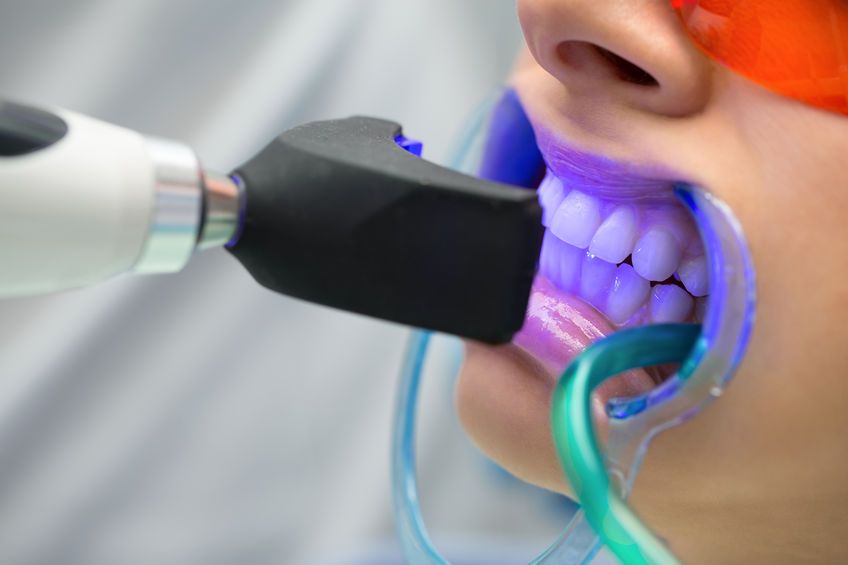
LED whitening in one or two sessions, or take-home whitening with custom trays, always after checking your teeth and gums. How each option works.
Teeth whitening clinic
Teeth whitening is one of the most widely used treatments in cosmetic dentistry thanks to its proven effectiveness and how quickly you see results.
If you want a more attractive smile, we offer you the most advanced and effective cosmetic dentistry techniques, made possible by the development of new and innovative materials and procedures.
The secret behind every professional teeth whitening treatment is the same:
“applying a hydrogen peroxide gel”
All professional teeth whitening treatments are based on the same principle:
“applying a hydrogen peroxide gel”
1. LED LIGHT TEETH WHITENING
One or two in-clinic LED whitening sessions of around 45 minutes can restore the whiteness of your teeth. This treatment stands out for how fast it is.
In the first stage, the gums are protected to prevent irritation. The whitening gel is then applied.
Finally comes photoactivation, which involves shining a cold light onto the teeth.
During this process a professional cold-light lamp activates the molecules of the whitening gel, made up mainly of hydrogen peroxide, and the lamp's cold radiation speeds up the release of the whitening molecules.
“Alternating this type of whitening with tray or take-home whitening considerably improves the results
Alternating this type of whitening with tray or take-home whitening considerably improves the results
2. TAKE-HOME TEETH WHITENING
Tray whitening, or take-home whitening, can be done at home. It is the most widely used whitening technique because it is easy to apply, convenient and effective. One advantage is that it is less invasive than LED whitening, so if your teeth are quite sensitive this treatment may suit you better.
How long the treatment lasts varies from patient to patient. The deciding factor is that you control it yourself.
As a rule, this type of teeth whitening usually takes two to six weeks, depending on how long you wear the trays each day (one to three hours).
Frequently asked questions
Does whitening damage the enamel?
Carried out by a professional and with the right products and concentrations, it does not damage the enamel. What it does frequently produce is temporary sensitivity to cold for a few days, which is managed with desensitising toothpastes and disappears once treatment ends.
Does it also whiten crowns and fillings?
No. Whitening works on the natural tooth; crowns, veneers and composites keep their colour. That is why, if there are visible restorations, the teeth are whitened first and the restorations are replaced afterwards so that they match the new shade.
Are the kits sold in the supermarket any good?
They usually contain very low concentrations or abrasive products, and standard trays do not fit your mouth, which means the gel contacts the gum. The result is poor and irritation is common. It is worth first assessing whether the tooth is a candidate.
What is the best way to whiten your teeth?
The one that starts with a diagnosis: before whitening, cavities, inflamed gums and leaking restorations have to be ruled out, and we need to know why the tooth has darkened. From there, combining an in-clinic session with at-home maintenance using custom trays is what usually gives the best result and the least sensitivity.
What are the drawbacks of teeth whitening?
Temporary sensitivity to cold is the most common, along with some gum discomfort if the gel touches it. It does not whiten crowns or fillings, the result is not permanent and not all stains respond the same: those caused by tetracyclines or by trauma improve less. On teeth with cracks or decay it is not done until those are treated.
How do you get rid of yellowing on teeth?
First you have to see where it comes from: tartar and external stains from coffee, tea, wine or tobacco are resolved with a cleaning; the tooth's own yellow tone responds to whitening; and enamel wear that exposes the dentine cannot be whitened, it has to be restored. Home remedies with bicarbonate of soda or lemon wear the enamel down and make the problem worse.
Related articles

Cosmetic dentistry: the art of designing your smile
Veneers, whitening, gingival contouring and Digital Smile Design: the treatments that allow you to design your smile before touchi…
Teeth Whitening
Pharmacy kits, at-home trays and in-clinic LED-light whitening: how they differ, what results to expect, and why a check-up comes …
Dr Fernando Rincón Granados