
Tratamientos
Published on
Do you need a crown after a root canal?
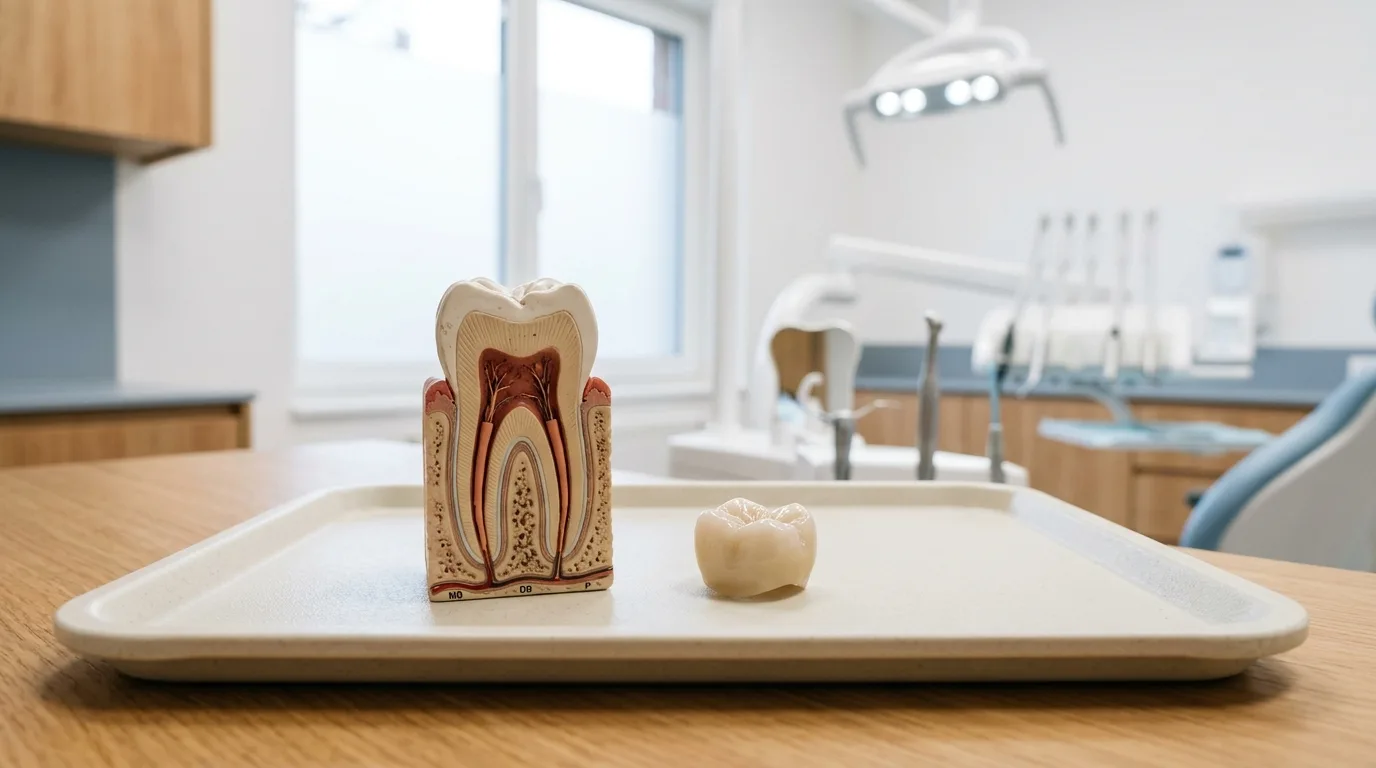
Do you need a crown after a root canal? Why the tooth becomes more fragile, when a filling will do, what a post is and how long you should wait.
Why a root-filled tooth is more fragile
A root canal removes the inflamed or infected pulp from inside the tooth, cleans the canals and seals them; we explain it in root canal treatment: what it is and when it's needed. The treatment solves the problem inside, but the tooth that remains isn't as strong as it was. The main reason is the loss of tooth structure:
- What had already been destroyed by the decay or fracture that led to the root canal.
- The opening that has to be made in the crown of the tooth to reach the canals.
- Old fillings that the tooth often already had.
The less healthy tooth is left, and especially if the side walls have been lost, the easier it is for the force of chewing to crack or split it. This is particularly important in molars and premolars, which are the teeth that bear the most load.
What's more, a tooth without a nerve gives no warning signs with cold or heat, so a crack can spread unnoticed until the tooth breaks.
When a filling is enough and when a crown or an onlay is advisable
Not every root-filled tooth needs a crown. The dentist decides case by case, depending on how much healthy tooth is left, which tooth it is and how you bite. Broadly speaking:
| Option | What it is | When it's usually considered |
|---|---|---|
| Filling | The opening and the missing part are filled with a tooth-coloured material, usually in a single appointment. | Front teeth, or teeth that have lost little structure and still have their walls. |
| Onlay | A custom-made piece that is bonded to the tooth and covers the cusps without having to reshape the whole tooth. | Molars and premolars with moderate loss, when the cusps need protecting and enough of the walls remain. |
| Crown or cap | A custom-made piece that covers the whole tooth above the gum. | Teeth that have lost a lot of structure, badly weakened molars, and teeth that have cracks or need a post. |
What the last two options have in common is that they cover the cusps, so that the force of your bite is spread out and doesn't split the tooth open like a wedge. In root-filled molars and premolars, long-term studies link this protection with better tooth survival, which is why it is often recommended for those teeth.
Post and core: what they are
Before a crown is fitted, the tooth needs a solid base to support it. That base is the core build-up, sometimes simply called the core: the missing part of the tooth is rebuilt with restorative material and given the right shape to receive the crown.
When so little tooth is left that the core would have nothing to hold on to, a post is placed: a small piece that is inserted into one of the canals that have already been sealed and acts as an anchor. Fibre posts are commonly used today, although there are other materials.
Something many people don't know: a post doesn't strengthen the tooth. Its job is to hold the core in place, not to make the root stronger. That's why it is only used when needed. What protects the tooth most in the long term is keeping as much healthy tooth as possible and, in particular, leaving a collar of your own tooth all the way round, under the crown, for the crown to grip. This is what dentists call the ferrule effect.
How long to wait between the root canal and the crown
There's no single timeframe, but the general advice is not to put it off. While the tooth has a temporary filling it is more vulnerable, for two reasons:
- It can fracture when you chew, because the temporary filling doesn't protect the cusps.
- Temporary materials don't seal indefinitely: over time, saliva and bacteria can leak into the canals and reinfect them.
The usual approach is to place the permanent restoration as soon as the tooth is free of symptoms, often at the same appointment as the root canal or shortly afterwards. If a crown is also needed, it is scheduled for the following weeks. In some cases the dentist prefers to wait a while to check that the infection is clearing up before fitting the permanent crown: it's a clinical decision that depends on each tooth.
In the meantime, chew on the other side and avoid hard or sticky foods with that tooth.
Is a root canal permanent? What determines how long it lasts
A root canal aims to save the tooth for many years, and in many cases it does. But permanent doesn't mean it can't fail. How long it lasts depends above all on:
- The canals being thoroughly cleaned and sealed. A canal that isn't found can remain infected.
- The restoration sealing well and not letting bacteria in from the mouth.
- The tooth being protected against fracture, which is one of the most common reasons for losing a root-filled tooth.
- No new decay appearing at the edge of the filling or crown, and the gum staying healthy.
- Check-ups, with follow-up X-rays to check that the bone around the root is recovering.
If, over the years, a root-filled tooth becomes infected again, it can often be treated again with root canal retreatment instead of being extracted.
What happens if the tooth isn't restored in time
It happens more often than you might think: the pain goes away after the root canal, the tooth stops bothering you and the appointment for the restoration keeps getting put off. The risk is real:
- Fracture. If part of the tooth above the gum breaks, it can often be repaired. If the fracture reaches the root or splits the tooth vertically, it often can no longer be saved and has to be extracted.
- Reinfection. If the temporary filling wears down or falls out, bacteria can recolonise the canals and the treatment may have to be repeated.
- Decay under the temporary filling, which progresses painlessly because the tooth no longer has a nerve.
In all these cases, what could have been solved with a restoration ends up as a longer, more expensive treatment, or in losing the tooth that the root canal had made it possible to save.
If you have a root-filled tooth that hasn't been restored
If you've had a root canal and the tooth still has a temporary filling, or you're not sure whether it needs a crown, it's best to have it checked as soon as possible. In our endodontics unit we assess how much tooth is left and explain which restoration makes sense in your case.
Based on reliable sources
Prepared by our team from the references listed below. This is general information and does not replace a consultation.
Article pending review by one of our dentists.
References (4)
- MedlinePlus (Biblioteca Nacional de Medicina de EE. UU.). Tratamiento de conductos: MedlinePlus enciclopedia médica Open
- Aquilino SA, Caplan DJ (2002). Relationship between crown placement and the survival of endodontically treated teeth Open
- Ng YL et al. (2010). Tooth survival following non-surgical root canal treatment: a systematic review of the literature Open
- Juloski J et al. (2012). Ferrule effect: a literature review Open