
Manolo Rincón
Healthcare professional, businessman, painter and club president: the life of Manuel Rincón Granados, founder of the Rincón group in Málaga.
Some people fit on a single business card. Manuel Jesús Rincón Granados, Manolo Rincón (Torre del Mar, 1952), needs several: healthcare professional, businessman, painter, basketball club president, campaigner for his home town. And even so, those who know him tend to sum him up in a single word: the one he himself chose to name his boat — Empatía.
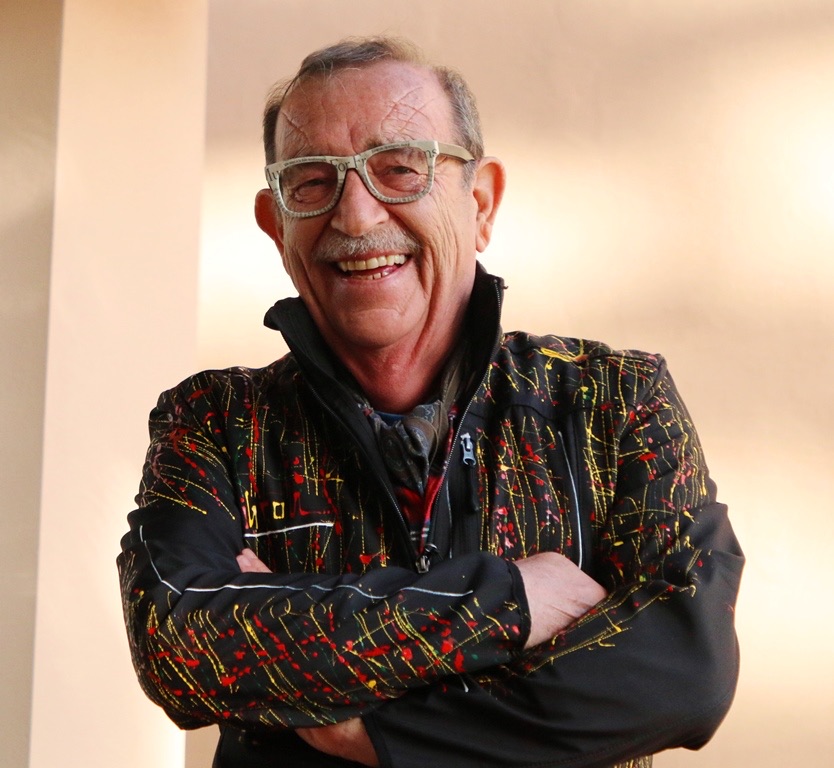
The son of the village nurse
His father, Manuel Rincón Béjar, was the village nurse in Torre del Mar for more than thirty years: the local health worker who gave injections, dressed wounds and reached people's homes before the doctor did, by day and by night. Manolo, the eldest of five siblings, began as a child to go along with him — the bicycle he rode behind his father's medical bag is, decades later, one of the motifs that recur most often in his painting.
He studied Nursing and Physiotherapy: his father's trade, now with a qualification. And he practised with his hands before he did with his signature. In 1972 his father founded Clínica Rincón; in 1978, on his father's death, Manolo took charge at the age of 26 and, «as a tribute to the figure of his father», he drove the family business forward «with the aim of improving the town's healthcare shortcomings». He never stopped thinking like the clinician he had been: diagnosis first, everything else afterwards.
The businessman who started again
Out of that practice grew one of the leading healthcare groups in Málaga: five medical centres across Torre del Mar, Nerja, Rincón de la Victoria, Málaga and Torremolinos, a network of dental clinics and an assisted reproduction institute. In December 2016, most of that network was integrated into a national hospital group — the full story is told here.
What is telling is what he did next, at the age of 64: instead of retiring, that same year he set up the Fundación that bears his father's name, he grew Rincón Dental and Rincón Fertilidad, and in 2024, at the age of 72, he opened Rincón Salud in Torre del Mar — returning to the business he had left, in the same town where it all began.
His rule, in his own words, is to «give back to society all that he has received from it», and there are dates that bear it out: in March 2020 he made his hospital in Rincón de la Victoria available to the authorities to care for covid patients; in 2025 he signed an agreement with Vélez-Málaga Town Council for free dental care for people in vulnerable situations and a youth employment agreement with Cruz Roja Málaga; in 2026, Rincón Salud donated 101 mammograms to the women's associations of the Axarquía.
The painter
He began painting in 1974, at the age of 22 and self-taught, alongside the generation that shaped painting in Málaga — Evaristo Guerra, Francisco Hernández, Pimentel, Casamayor. From the very beginning he has painted boats, houses and bicycles; fifty years on he is still painting the same, and has now produced more than six thousand works.
In 1996 he took up the action painting that would earn him the nickname «the Pollock of Torre del Mar»: he works with palette, brush and syringe — the health worker and the painter in the same hand. His great subject is the sea that washes his homeland; his most quoted painting, Chapapote, he painted after the sinking of the Prestige and did not consider finished until the day the oil slick stopped appearing on the news. He has exhibited in Torre del Mar, Nerja, Málaga and Torremolinos, in 2013 he took his work to the streets of Manhattan, and in 2017 he brought together sixteen pieces in Cártama in the exhibition Deporte por amor al arte, whose proceeds went entirely to sport in Málaga. He summed it up there himself: «everything I do always comes from the soul».
The best portrait of the painter was written by his friend Manuel Alcántara, winner of the Spanish national journalism prize:
«Manolo Rincón likes painting, and painting likes Manolo Rincón. I don't know whether what he does can be called expressionism, but I am sure he has invented a new -ism: rinconismo. Manolo paints as he is: insubordinate and loyal, lavish and steadfast.»
In 2019 the painting became a garment: he launched Manolo Rincón Art Collection, clothing and objects printed with his work, made entirely in Spain, with part of the profits going to the athletes and clubs he sponsors. The first collection was called, of course, Empatía, and it was presented in Málaga as a tribute to Alcántara, who had died three months earlier. His designs even inspired a jacket worn by David Bisbal.
The patron
This is the side of him that all of Málaga knows: «the great patron of sport in Málaga» is not a kind headline, it is an accounting description. Today the Fundación Rincón — set up in 2016 under his father's name, with the motto «La Salud y el Deporte por amor al arte» — supports more than 70 clubs, athletes and associations, with an unwritten rule: grassroots, adapted and women's sport first.
- Basketball. He chaired and professionalised CB Axarquía, which as Clínicas Rincón was a Unicaja feeder club and a benchmark in LEB Oro, reaching the playoffs for promotion to the ACB. That team was home to four players who went on to the NBA: Domantas Sabonis, Álex Abrines, Vítor Faverani and Ognjen Kuzmić. In 2025 he sponsored Unicaja once again, and in 2026 — at the age of 74 — he announced the return of the Axarquía to national competition: «to be again what we once were […] a basketball project that excites people».
- Women's handball. In 2014, hours after the Málaga club's promotion to the División de Honor and with the organisation in difficulty, he took on half of its budget. The team was renamed Rincón Fertilidad Málaga and in less than a year it won the Copa de la Reina, the Supercopa de España and the EHF European Cup.
- Adapted sport. More than a decade alongside the BSR AMIVEL wheelchair basketball club, sponsor of Málaga Genuine since its beginnings and founder of Juventud Axarquía, the district's inclusive football team.
- And his paintings as currency. At his galas he gives one of his works to every sponsored club, so that they can also raise funds with it; his painting was the trophy for the «Siempre Fuerte» awards of the Fundación Málaga CF.
The trophy of his Galas SuperArte is the Fenicio de Honor: the donkey that was the mascot of that Clínicas Rincón basketball team. His explanation is probably his most honest self-portrait:
«The donkey is steadfast, good-natured, hard-working, helpful and a team player. And these are the values I have always been proud of and that we try to encourage from the Fundación.»
The neighbour
On 27 April 1987 he founded the residents' movement for the independence of Torre del Mar, which at its first election won four council seats in Vélez-Málaga. He defended the cause for decades and in every office it took — from the town council plenary, where he was spokesperson, to the Supreme Court, the Constitutional Court and the Strasbourg Court. He wryly called himself the «moral mayor» of his home town. He did not win — Torre del Mar is still part of Vélez-Málaga — but he still practises neighbourhood politics: his latest proposal in the municipal register was to rename the seafront promenade in honour of a distinguished son of Málaga.
The awards
- 2017 — Leading champion of Andalusian sport (AGESPORT); sports patronage award from Nerja Town Council; recognition from the Andalusian Federation of Sports for People with Physical Disabilities.
- 2021 — Silver Medal for Sporting Merit from the Royal Spanish Handball Federation. Honorary president of UD Torre del Mar.
- 2022 — Malagueño del Año de la Feria, alongside names such as Antonio Banderas and Manuel Alcántara (Peña El Gazpachuelo).
- 2024 — «El abrazo del alma»: the tribute from Málaga basketball, with the 200 children of the All Star Minibasket embracing him at Los Guindos and the Martín Carpena arena on its feet that same night.
- 2025 — 🏅 Bandera de Andalucía for an Outstanding Career, presented in Málaga by the Junta de Andalucía and the Diputación: official recognition of half a lifetime devoted to his homeland.
Empathy
From the practice to the group, from the brush to the court, the constant is the same: the conviction that people should be spoken to while looking them in the eye, that they should have what is happening to them explained, and that they should be accompanied. That word written on his boat — the one that gave its name to his first collection and its argument to his best-loved painting — is also the one this group tries to keep written into every consultation.