
Forschung: was wir untersucht und veröffentlicht haben
Neben der Betreuung von Patientinnen und Patienten hat das Team an Forschungsprojekten in Genetik und Embryologie mitgewirkt, viele davon gemeinsam mit der Universität Málaga.
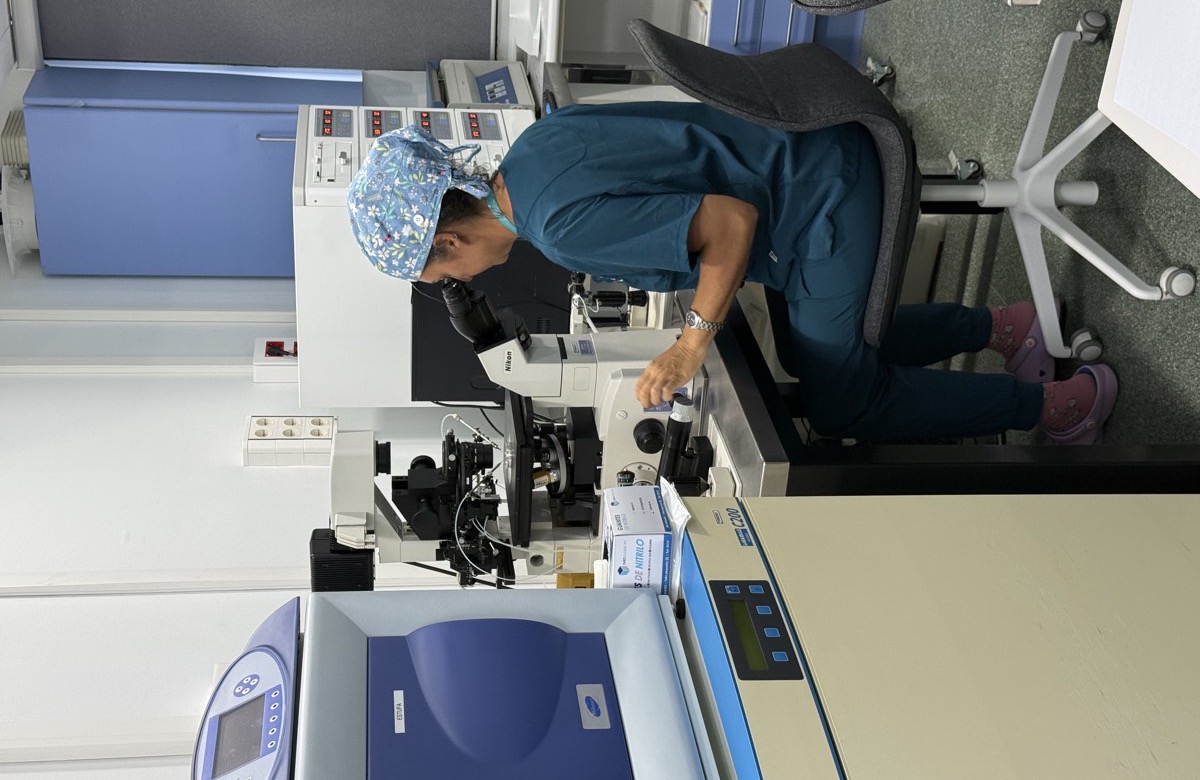
Mit wem und woran
Das Institut hat mit der Abteilung für Molekularmedizin von Clínicas Rincón und mit Forschungsgruppen der Universität Málaga zusammengearbeitet. Dazu gehört die Gruppe von Dr. Armando Reyes Engel vom Institut für Biochemie und Molekularbiologie der Medizinischen Fakultät. Außerdem hat es am Förderprogramm Torres Quevedo zur Ausbildung von Forschenden teilgenommen.
Im Mittelpunkt standen zwei Forschungslinien. Erstens die Präimplantationsdiagnostik (die Untersuchung der Embryonen vor dem Transfer) bei seltenen Erkrankungen. Eine davon ist die Paramyotonia congenita, eine erbliche Ionenkanalerkrankung der Muskulatur, die vor allem bei Kälte Steifheit verursachen kann. Zweitens der Zusammenhang zwischen bestimmten genetischen Varianten und der Einnistung des Embryos oder frühen Schwangerschaftsverlusten.
Auszeichnungen
- 2011 · Europäischer Kongress für Humanreproduktion (ESHRE), Stockholm. Arturo Reyes Palomares, Embryologe und Forscher, der damals zum Team des Instituts gehörte, erhielt den Fertility Society of Australia Exchange Award. Die ausgezeichnete Arbeit, entstanden mit der Universität Málaga, untersuchte Varianten des Serotonintransporter-Gens und frühe Schwangerschaftsverluste bei Behandlungen mit gespendeten Eizellen.
- 2012 · Nationaler Kongress der Spanischen Fertilitätsgesellschaft (SEF), Granada. Preis für den besten klinischen Beitrag, den Arturo Reyes Palomares im Rahmen seiner Doktorarbeit vorstellte: «Influencia de polimorfismos genéticos asociados al metabolismo de la 5-HT sobre los resultados de FIV/ICSI en receptoras de óvulos donados». 5-HT ist Serotonin: Die Arbeit setzt also dieselbe Forschungslinie fort.
Veröffentlichungen
Arbeiten des Institutsteams (2004-2022)
Von Mitgliedern des Teams verfasst, mehrere davon gemeinsam mit der Universität Málaga.
- Reyes Palomares A, Ruiz-Galdón M, Liu K, Reyes-Engel A, Rodriguez-Wallberg KA. Profiling the influence of gene variants related to folate-mediated one-carbon metabolism on the outcome of in vitro fertilization (IVF) with donor oocytes in recipients receiving folic acid fortification. International Journal of Molecular Sciences, 2022.
- Palomares AR, Castillo-Domínguez AA, Ruiz-Galdón M, Rodriguez-Wallberg KA, Reyes-Engel A. Genetic variants in the p53 pathway influence implantation and pregnancy maintenance in IVF treatments using donor oocytes. Journal of Assisted Reproduction and Genetics, 2021.
- Cortés-Rodríguez M, Royo JL, Reyes-Palomares A, Lendínez AM, Ruiz-Galdón M, Reyes-Engel A. Sperm count and motility are quantitatively affected by functional polymorphisms of HTR2A, MAOA and SLC18A. Reproductive BioMedicine Online, 2018.
- Lendínez AM, Palomares AR, Pérez-Nevot B, Cortés-Rodríguez M, Ruiz-Galdón M, Reyes-Engel A. Differential behavior of serum and red blood cell folate during a treatment with levofolinic acid. Gender differences. Clinical Laboratory, 2014.
- Palomares AR, Lendínez-Ramírez AM, Pérez-Nevot B, Cortés-Rodríguez M, Martínez F, Garrido N, Ruiz-Galdón M, Reyes-Engel A. Genetic polymorphisms of serotonin transporter and receptor 1A could influence success during embryo implantation and maintenance of pregnancy. Fertility and Sterility, 2013.
- Palomares AR, Lendínez-Ramírez AM, Ruiz-Galdón M, Reyes-Engel A. Low sex ratio in children of professional basketball players in Spain. Andrologia, 2012.
- Mayor-Olea A, Callejón G, Palomares AR, Jiménez AJ, Gaitán MJ, Rodríguez A, Ruiz M, Reyes-Engel A. Human genetic selection on the MTHFR 677C>T polymorphism. BMC Medical Genetics, 2008.
- Callejón G, Mayor-Olea A, Jiménez AJ, Gaitán MJ, Palomares AR, Martínez F, Ruiz M, Reyes-Engel A. Genotypes of the C677T and A1298C polymorphisms of the MTHFR gene as a cause of human spontaneous embryo loss. Human Reproduction, 2007.
- Rienzi L, Martínez F, Ubaldi F, Minasi MG, Iacobelli M, Tesarik J, Greco E. Polscope analysis of meiotic spindle changes in living metaphase II human oocytes during the freezing and thawing procedures. Human Reproduction, 2004.
- Tesarik J, Ubaldi F, Rienzi L, Martínez F, Iacobelli M, Mendoza C, Greco E. Caspase-dependent and -independent DNA fragmentation in Sertoli and germ cells from men with primary testicular failure: relationship with histological diagnosis. Human Reproduction, 2004.
Arbeiten von Kooperationspartnern
Sie stammen von Gruppen, mit denen das Institut zusammengearbeitet hat. Zwei haben keine Autoren aus dem Zentrum; die dritte, ein Übersichtsartikel, dankt der Fundación Rincón für ihre Unterstützung.
- Reyes Palomares A, Rodriguez-Wallberg KA. Update on the epigenomic implication of embryo cryopreservation methods applied in assisted reproductive technologies with potential long-term health effects. Frontiers in Cell and Developmental Biology, 2022.
- Miranda-Sayago JM, Fernández-Arcas N, Benito C, Reyes-Engel A, Carrera J, Alonso A. Lifespan of human amniotic fluid-derived multipotent mesenchymal stromal cells. Cytotherapy, 2011.
- Marchal C, Redondo M, Reyes-Engel A, Perea-Milla E, Gaitán MJ, Machuca J, Díaz F, Caballero J, Carnero J. Association between polymorphisms of folate-metabolizing enzymes and risk of prostate cancer. European Journal of Surgical Oncology, 2008.
Frühere Veröffentlichungen von Francisco Martínez Díaz (1999-2003)
Sie entstanden vor der Eröffnung des Zentrums und sind daher keine Arbeiten des Instituts: Sie belegen den Werdegang des Embryologen, der sie verfasst hat.
- Ubaldi F, Rienzi L, Baroni E, Ferrero S, Iacobelli M, Minasi MG, Sapienza F, Martínez F, Cobellis L, Greco E. Implantation in patients over 40 and raising FSH levels: a review. Placenta, 2003.
- Rienzi L, Ubaldi F, Minasi MG, Iacobelli M, Martínez F, Tesarik J, Greco E. Blastomere cytoplasmic granularity is unrelated to developmental potential of day 3 human embryos. Journal of Assisted Reproduction and Genetics, 2003.
- Rienzi L, Ubaldi F, Martínez F, Iacobelli M, Minasi MG, Ferrero S, Tesarik J, Greco E. Relationship between meiotic spindle location with regard to the polar body position and oocyte developmental potential after ICSI. Human Reproduction, 2003.
- Tesarik J, Martínez F, Rienzi L, Ubaldi F, Iacobelli M, Mendoza C, Greco E. Microfilament disruption is required for enucleation and nuclear transfer in germinal vesicle but not metaphase II human oocytes. Fertility and Sterility, 2003.
- Fulka J Jr, Martínez F, Tepla O, Mrazek M, Tesarik J. Somatic and embryonic cell nucleus transfer into intact and enucleated immature mouse oocytes. Human Reproduction, 2002.
- Tesarik J, Martínez F, Rienzi L, Iacobelli M, Ubaldi F, Mendoza C, Greco E. In-vitro effects of FSH and testosterone withdrawal on caspase activation and DNA fragmentation in different cell types of human seminiferous epithelium. Human Reproduction, 2002.
- Rienzi L, Ubaldi F, Iacobelli M, Ferrero S, Minasi MG, Martínez F, Tesarik J, Greco E. Day 3 embryo transfer with combined evaluation at the pronuclear and cleavage stages compares favourably with day 5 blastocyst transfer. Human Reproduction, 2002.
- Martínez F, Rienzi L, Iacobelli M, Ubaldi F, Mendoza C, Greco E, Tesarik J. Caspase activity in preimplantation human embryos is not associated with apoptosis. Human Reproduction, 2002.
- Mendoza C, Ruiz-Requena E, Ortega E, Cremades N, Martínez F, Bernabeu R, Greco E, Tesarik J. Follicular fluid markers of oocyte developmental potential. Human Reproduction, 2002.
- Rienzi L, Greco E, Ubaldi F, Iacobelli M, Martínez F, Tesarik J. Laser-assisted intracytoplasmic sperm injection. Fertility and Sterility, 2001.
- Martínez F, Tesarik J, Martín CM, Soler A, Mendoza C. Stimulation of tyrosine phosphorylation by progesterone and its 11-OH derivatives: dissection of a Ca2+-dependent and a Ca2+-independent mechanism. Biochemical and Biophysical Research Communications, 1999.
- Mendoza C, Cremades N, Ruiz-Requena E, Martínez F, Ortega E, Bernabeu S, Tesarik J. Relationship between fertilization results after intracytoplasmic sperm injection, and intrafollicular steroid, pituitary hormone and cytokine concentrations. Human Reproduction, 1999.